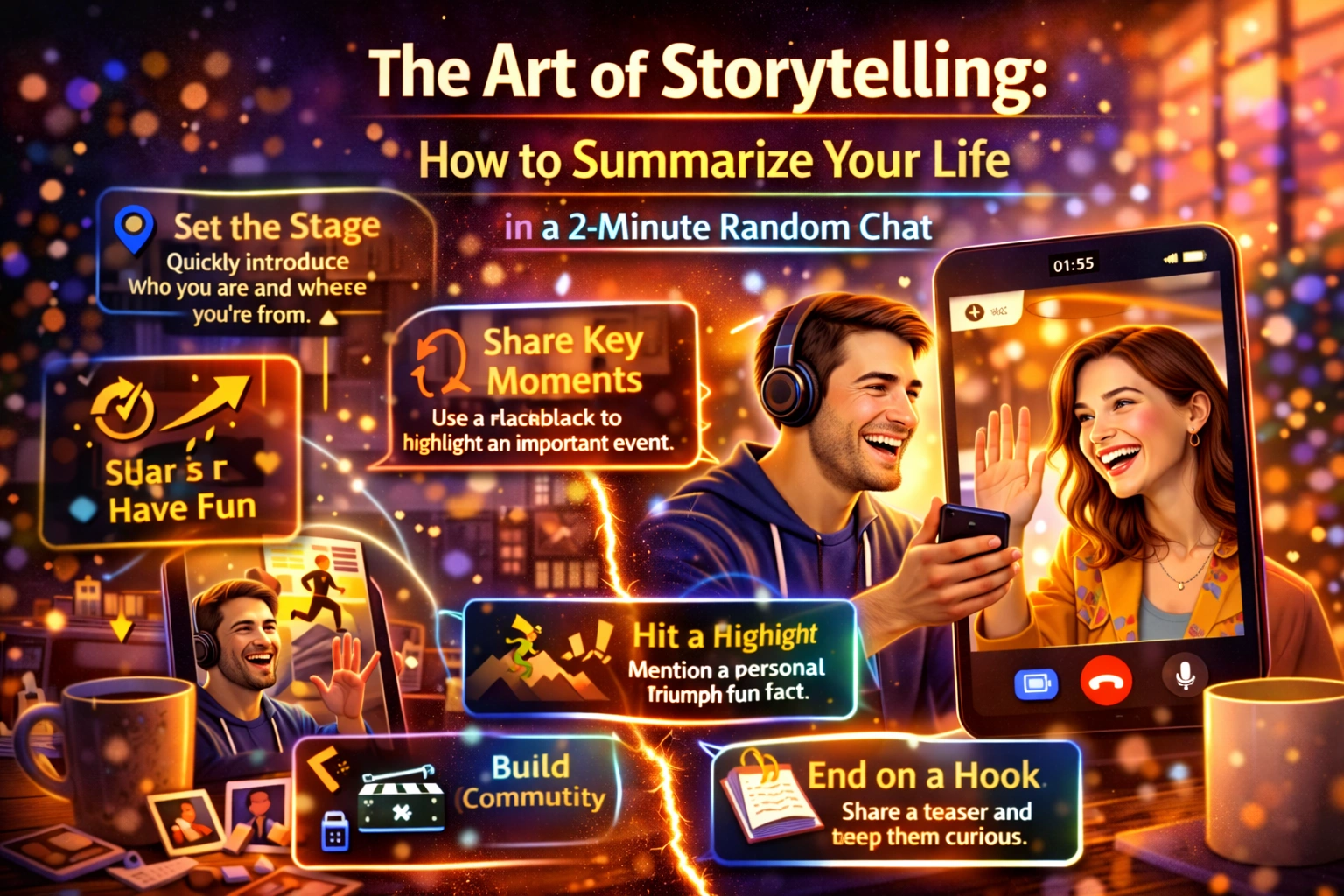
The Art of Storytelling: How to Summarize Your Life in a 2-Minute Random Chat
Published by Chatzyo Insights | Niche Interests & Brand Utility
The modern digital attention span is notoriously fragile. When you log into a 1-on-1 random video chat platform, you are entering one of the most ruthless attention economies on the internet. Your conversation partner has their finger hovering over the "Next" button. You have approximately five seconds to prove you are not a bot, ten seconds to prove you are interesting, and perhaps two minutes to leave a lasting impression before the transient nature of the web pulls you apart.
How do you convey the complexity of your human experience in 120 seconds? The answer does not lie in talking faster; it lies in mastering the art of micro-storytelling.
In this educational guide, we delve into the psychology of the "digital elevator pitch." We will explore why traditional introductions fail, how to structure a compelling two-minute narrative, and why mastering this skill is the ultimate antidote to modern digital fatigue.
The Psychology of the Micro-Story
Human beings are not wired to process spreadsheets, lists of facts, or dry biographies; we are biologically hardwired for narrative. When you tell a story, the listener's brain waves actually begin to synchronize with yours—a phenomenon neuroscientists call "neural coupling."
In the post-algorithm era of socializing, where people are desperately seeking genuine connection over curated perfection, a good story is a lifeline. However, a two-minute window requires aggressive editing. You cannot tell the epic saga of your childhood. You must learn to deliver a "micro-story"—a compressed narrative arc that contains a hook, a conflict, and a resolution (or an open-ended question), all delivered before the metaphorical timer runs out.
Classical literature often starts in media res—in the middle of the action. Micro-storytelling requires the same approach. Skip the boring buildup ("I woke up today, had coffee, drove to work...") and start right at the point of interest ("I was standing in the elevator when the power went out...").
Ditching the Résumé: Why "What Do You Do?" is a Trap
The most common, and arguably the most fatal, mistake people make in random online encounters is reciting their résumé.
"Hi, I'm a software engineer from Coimbatore. I am 28 years old. I like movies."
While factual, this introduction is entirely devoid of emotional resonance. It invites a dead-end response like, "Oh, cool." To captivate a stranger, you must replace your factual résumé with your emotional résumé. Instead of stating your job title, state the specific, quirky problem you are trying to solve right now. Instead of listing a hobby, describe the irrational passion you have for a specific niche.
Consider the difference when using targeted chat icebreakers integrated into your intro:
"I spend 40 hours a week arguing with computer code, but my real obsession right now is trying to bake the perfect sourdough bread, and I have failed spectacularly three times this week."
This instantly provides the listener with a relatable struggle, a sense of humor, and multiple conversational "hooks" they can grab onto. It transforms you from a generic archetype into a specific, memorable character.
The 120-Second Narrative Arc
If you find yourself holding the conversational floor, here is how to structure a micro-story effectively within the two-minute timeframe:
- Seconds 0-15 (The Hook): Start with an intriguing statement or a mildly controversial (but friendly) opinion. Example: "I just realized that 90% of adult life is just deciding what to eat for dinner."
- Seconds 15-60 (The Context/Conflict): Briefly explain why you have this opinion. Share a highly specific, recent anecdote. Specificity is the soul of storytelling. Don't say "I had a bad meal." Say "I accidentally ordered something so spicy I saw through time."
- Seconds 60-90 (The Pivot): This is where you transition from your story to their reality. Relate your anecdote to a broader human experience.
- Seconds 90-120 (The Hand-Off): End your micro-story with an open-ended question. Never finish a story with a period; finish it with a question mark. Pass the conversational ball back to them.
Adapting to Your Audience: Global vs. Local Context
A crucial element of storytelling is knowing your audience, which can be tricky on random platforms. The details of your micro-story must shift depending on the portal you enter.
If you are in a global pool speaking to someone in a USA chat room, your story needs to rely on universal human themes—embarrassment, joy, frustration with technology, or weather. Niche cultural references will fall flat and cause the listener to disconnect.
Conversely, if you are utilizing hyper-local filters and enter an India chat or a dedicated Tamil chat environment, you should actively leverage shared cultural context. A two-minute story about the chaos of local traffic, the specific taste of a regional street food, or a nuanced cultural observation will instantly build a bridge of familiarity and trust.
The "Ping-Pong Effect" and Active Listening
Finally, it is vital to remember that a two-minute chat is not an audition for a one-person play. The goal of your micro-story is not simply to be heard; it is to act as a catalyst for a shared experience.
As discussed in our exploration of why short conversations are highly engaging, the best interactions resemble a fast-paced game of ping-pong. If you spend 115 seconds talking, you have failed the assignment, regardless of how good the story was. The magic of these platforms lies in the rapid exchange of ideas.
When you pass the ball, you must engage in aggressive active listening. Because the visual cues are limited to a small webcam square, your verbal affirmations and follow-up questions must be sharp. Show the stranger that their micro-story is just as captivating to you as yours was to them.
Conclusion: Embracing Ephemeral Magic
Summarizing your life in a two-minute random chat is an exercise in letting go of ego. You cannot convey everything you are. You can only offer a small, brightly lit window into your current state of mind.
By ditching the boring résumé, utilizing the mechanics of micro-storytelling, and focusing on immediate, authentic connection, you can turn a fleeting digital encounter into a profoundly memorable human moment. In a world increasingly dominated by endless algorithmic feeds, the ability to tell a captivating story to a stranger in 120 seconds is nothing short of a superpower.
Frequently Asked Questions
In an anonymous, fast-paced digital environment, users decide whether to stay or click 'skip' within the first few seconds. Strong storytelling breaks through the mundane barrier of repetitive small talk, captures attention instantly, and forms a memorable human connection before the digital window closes.
The biggest mistake is reciting a 'résumé.' Listing your job title, your exact age, and your city is factual but socially boring. Instead of stating dry facts, compelling conversationalists share brief, emotion-driven anecdotes about what they are currently passionate about, struggling with, or finding humorous.
Focus on depth, not breadth. Do not try to explain your entire life story or summarize your entire week. Pick one specific, interesting aspect of your day or personality and dive into it with rich detail. Then, ask an engaging open-ended question to pass the conversational ball, turning a monologue into a dynamic exchange of ideas.