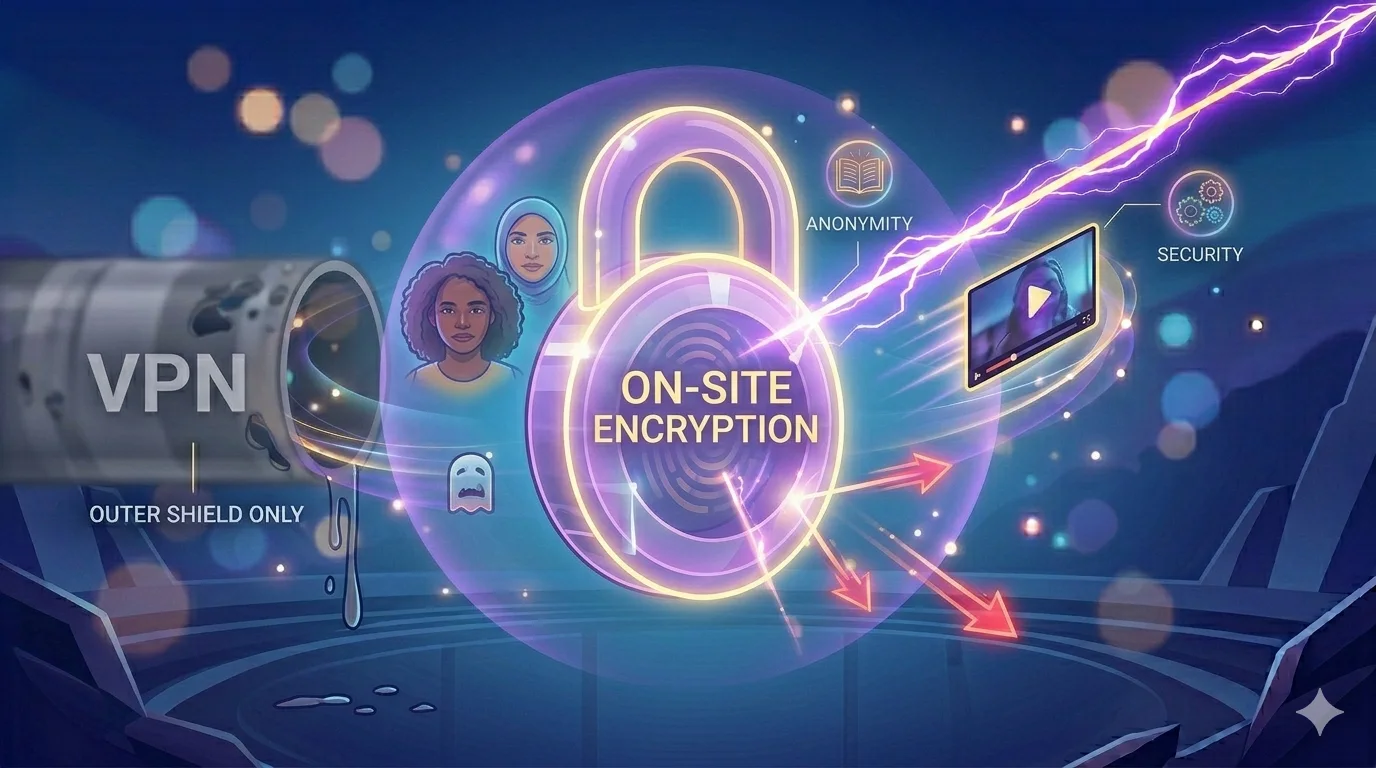
Beyond the VPN: Why On-Site Encryption is Your Best Defense Against Data Leaks
If you have watched a tech review or listened to a podcast in the last five years, you have undoubtedly heard an advertisement for a Virtual Private Network (VPN). They are universally marketed as the absolute, silver-bullet solution to all digital privacy concerns. The promise is enticing: flip a switch, and you instantly become invisible to hackers, governments, and your Internet Service Provider (ISP).
While VPNs are an excellent tool for general internet hygiene and masking your IP address, they suffer from a massive architectural blind spot when it comes to real-time communication. If the website you are visiting does not have robust, platform-level encryption, a VPN will not save your video data from being intercepted. In the fast-paced ecosystem of random video chat, true security must be engineered directly into the site itself. In this article, we dive into the cryptographic protocols that power modern on-site encryption, and why relying solely on a VPN is a dangerous half-measure.
The VPN Illusion: The Tunnel to Nowhere
To understand the limitation of a VPN, you must understand how it functions. A VPN creates a secure, encrypted "tunnel" between your device (like your laptop or smartphone) and the VPN company's server. Your ISP cannot see what data is traveling through this tunnel. This is fantastic for preventing local snooping.
However, once your data reaches the VPN server, it exits the tunnel and travels the rest of the way to the destination website. If that destination website is using outdated technology or centralized servers without proper encryption, your data is completely exposed for the second half of its journey. If you use a VPN to connect to an unencrypted video chat platform, the platform itself can still record your video, intercept your text messages, and leak your data in a server breach. The VPN only protected you for the first mile.
The Core of On-Site Encryption: DTLS and SRTP
At Chatzyo, we believe the burden of security belongs to the platform engineers, not the user. This is why we utilize the native encryption protocols built directly into WebRTC.
When you initiate a 1-on-1 video call, your browser does not simply start throwing raw video frames into the wild. It utilizes two advanced cryptographic standards to lock down the connection:
1. DTLS (Datagram Transport Layer Security)
Before any video or audio is shared, the two browsers must perform a handshake. DTLS is a protocol used to negotiate security keys securely over a UDP connection (the fast protocol we discussed in our WebRTC breakdown). DTLS ensures that even if someone is listening to the initial connection attempt, they cannot intercept the keys required to unlock the data stream. It prevents tampering and guarantees that the person you are communicating with is actually the person on the other end, mitigating impersonation attacks.
2. SRTP (Secure Real-Time Transport Protocol)
Once the DTLS handshake is complete and the secure keys are exchanged, SRTP takes over. SRTP is the armored truck that transports your actual media. It encrypts every single frame of video and packet of audio before it leaves your device. Only the specific stranger's browser you connected with holds the corresponding key to decrypt and play that media.
End-to-End Encryption in P2P Architecture
The combination of DTLS and SRTP within a Peer-to-Peer (P2P) network creates genuine End-to-End Encryption (E2EE). Because the media travels directly from your browser to the other user's browser, there is no central server in the middle to decrypt the data.
Contrast this with older, centralized video platforms. In legacy architectures, your encrypted data goes to a corporate server. The corporate server possesses the keys, decrypts your video, processes it (often running it through tracking algorithms or recording it for liability), re-encrypts it, and sends it to your partner. In this scenario, the corporation is the weak link. If their servers are breached, your private video is compromised. By utilizing pure P2P WebRTC, we eliminate the middleman entirely.
Defeating the Man-in-the-Middle (MitM) Attack
Imagine you are sitting in a cafe in Coimbatore, connected to public Wi-Fi, and you decide to hop into a regional chat room. Public Wi-Fi networks are notorious hunting grounds for hackers executing "Man-in-the-Middle" (MitM) attacks. A hacker intercepts the data flowing from your laptop to the cafe's router.
If you are not using a VPN, the hacker can see exactly which website you are visiting. However, because our platform enforces strict HTTPS and WebRTC's mandatory SRTP encryption, the hacker cannot see what you are doing on the site. If they intercept your video stream, they will only see a scrambled, cryptographic mess of alphanumeric gibberish. It would take a supercomputer thousands of years to crack the SRTP encryption key generated for that specific 5-minute conversation. The on-site encryption neutralizes the threat of the public network entirely.
Frequently Asked Questions About Encryption
Yes, we still recommend it! A VPN hides your IP address and prevents your Internet Service Provider from knowing you are visiting a chat site. Think of a VPN as your outer shield, and our on-site WebRTC encryption as your inner armor. Together, they provide maximum security.
No. DTLS and SRTP are specifically designed for real-time media. The encryption and decryption happen on a hardware level inside your device's processor in fractions of a millisecond, meaning your video remains completely lag-free.
Because we utilize P2P end-to-end encryption and do not record or route media through a central server, we do not possess the cryptographic keys to decrypt your active video streams. We cannot hand over what we physically do not have.
Conclusion: The Zero-Knowledge Philosophy
Privacy is not an add-on feature that users should have to purchase through a third-party application; it is a fundamental architectural requirement. By deeply integrating DTLS and SRTP encryption into the core of the browser experience, we embrace a "Zero-Knowledge" philosophy. We provide the digital space for you to connect, but we ensure that we remain entirely blind to the contents of that connection. When you combine strong on-site encryption with smart personal habits, your digital life remains securely your own.