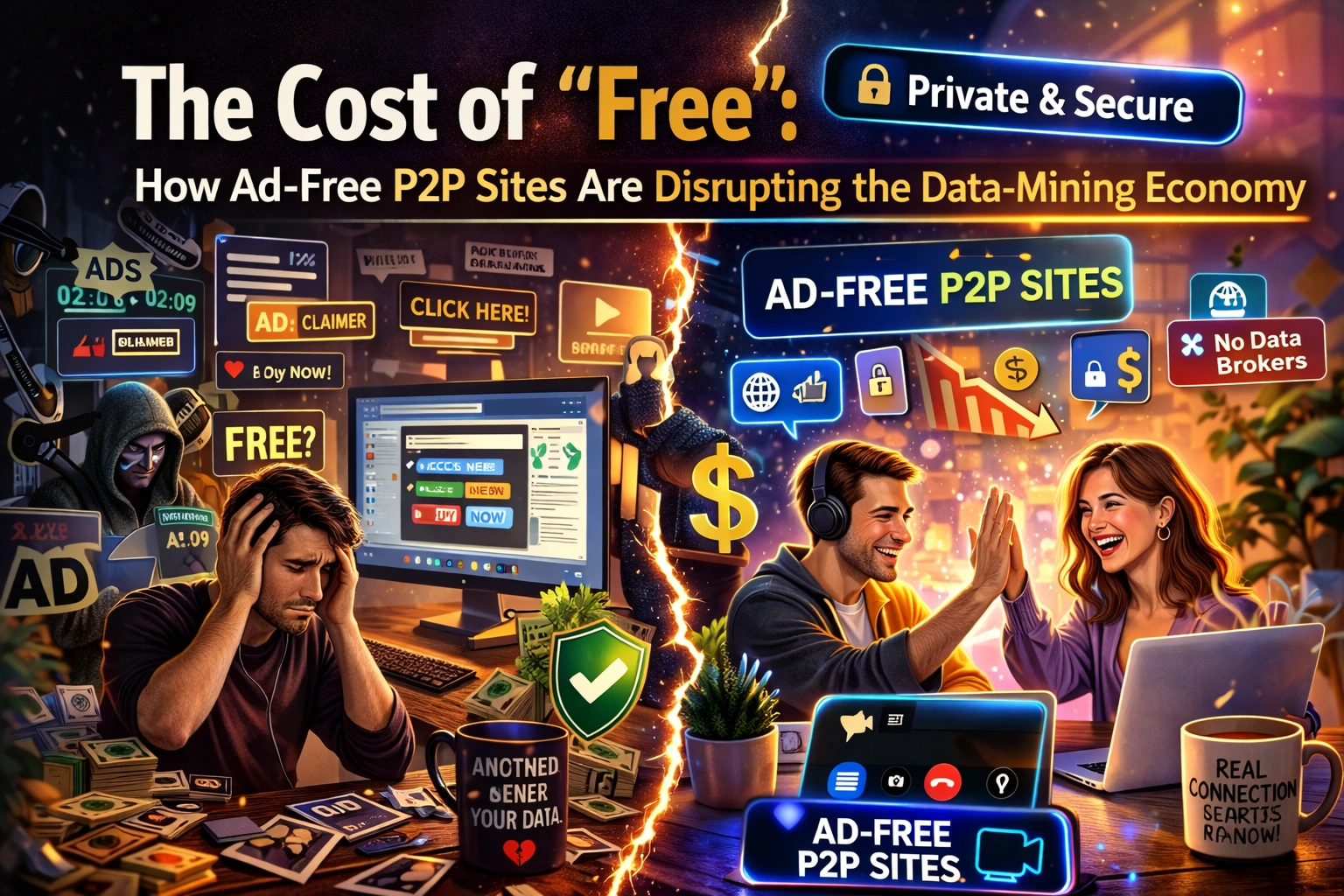
The Cost of "Free": How P2P Sites Are Disrupting the Data-Mining Economy
Published by Chatzyo Insights | Educational & Market Analysis
For the majority of the internet’s mainstream existence, the consumer expectation has been clear: social media, networking applications, and digital discovery platforms should be free to use. However, as the old Silicon Valley adage states, "If you are not paying for the product, you are the product." The reality of the Web 2.0 era is that nothing was truly free; users were simply paying with a currency far more valuable than fiat money: their personal data.
As we navigate through 2026, a profound technological awakening is occurring. Users are beginning to understand the immense psychological and societal toll of surveillance capitalism. At the same time, a new architectural framework—Peer-to-Peer (P2P) WebRTC—has reached maturity. This technology is not just upgrading how we experience random video chat; it is actively disrupting the multi-billion-dollar data-mining economy by rendering its core mechanisms obsolete.
In this educational analysis, we will explore the architecture of the data-mining economy, the true cost of centralized "free" platforms, and how the no-login revolution is returning digital sovereignty back to the consumer.
The Illusion of "Free" and Surveillance Capitalism
To understand the disruption, we must first understand the incumbent system. Traditional social networking applications operate on a "Client-Server" model. When you send a message, upload a photo, or start a video call, your device (the client) sends that massive payload of data to a central corporate server farm. These server farms require immense amounts of electricity, physical real estate, and ongoing maintenance.
To subsidize these astronomical operational costs and generate massive profits for shareholders, tech conglomerates created the data-mining economy. Every single action you take on a centralized platform is tracked, logged, and quantified. How long you look at a specific image, what time of day you log in, who you talk to, and your exact geolocation are all compiled into a comprehensive "Digital Dossier."
This dossier is then packaged and sold to third-party data brokers and advertisers in micro-second bidding wars. You are not the customer of these "free" platforms; the advertisers are. The constant surveillance creates an environment of digital fatigue, where users feel a constant, looming anxiety that their private lives are simply raw materials for an algorithmic assembly line.
Data mining isn't just about selling ads; it's about behavioral modification. The more data an algorithm has on you, the better it can predict—and ultimately influence—your behavior, keeping you glued to the screen to harvest even more data. Breaking this feedback loop requires a fundamental shift in network architecture.
The WebRTC Paradigm Shift: Bypassing the Server
The disruption of this economy relies heavily on an open-source project called Web Real-Time Communication (WebRTC). Instead of routing your data through a central, corporate-owned server, WebRTC facilitates a Peer-to-Peer (P2P) connection.
As we detailed in our guide on the future of WebRTC communication, the process is incredibly elegant. The platform's server simply acts as a digital switchboard operator. It introduces User A's browser to User B's browser. Once the "handshake" is established, the central server steps completely out of the way. The heavy, bandwidth-intensive video and audio data flows directly between the two peers.
This has two massive, market-disrupting implications:
- A Collapse in Overhead Costs: Because the platform does not process, store, or relay the video data, its server infrastructure costs are reduced by over 90%. P2P platforms can operate at a massive scale with a fraction of the budget of centralized apps.
- The Inability to Mine Data: If the video data never touches the platform's central server, the platform fundamentally cannot record, analyze, or mine the content of the conversation. The architecture itself enforces privacy.
The Zero-Data Philosophy and Ephemeral Identity
Lower server costs alone are not enough to defeat surveillance capitalism; a philosophical shift is also required. Even with P2P video routing, a platform could theoretically still force you to create an account, thereby tracking when you log in and who you match with.
This is where the zero-data philosophy becomes the final nail in the coffin for the data-mining economy. Modern discovery platforms are increasingly adopting strict "no-login" policies. By removing the requirement for an email address, phone number, or OAuth integration (like "Sign in with Google"), the platform deliberately destroys the concept of a persistent user profile.
When you enter an environment without a persistent account, your digital identity becomes completely ephemeral. Each session is an isolated event. There is no historical data to aggregate, no "user profile" to analyze, and therefore, absolutely nothing to sell to advertisers. For users looking to navigate the privacy risks of anonymous chat, finding a true "no-login" WebRTC platform is the gold standard of digital protection.
Redefining the Value Exchange
If these platforms aren't selling user data, how do they survive economically? The answer lies in transparent value exchange.
Because WebRTC drastically lowers operating costs, platforms can remain profitable through non-intrusive, contextual display advertising (which relies on the content of the webpage itself, rather than spying on the user's cross-site behavior). Alternatively, some platforms offer voluntary premium features—like specialized visual filters or prioritized matching queues—for a transparent, one-time fee. The crucial distinction is that the core product (the ability to connect with another human being) remains free, and the user's data remains their own property.
Conclusion: Reclaiming Digital Sovereignty
The transition from centralized, data-mining applications to decentralized, P2P communication networks is one of the most significant technological shifts of the decade. Consumers are realizing that the cost of "free" Web 2.0 platforms was simply too high. Surrendering your psychological profile, your location data, and your private conversations to corporate databases is no longer a trade-off that informed users are willing to make.
By leveraging WebRTC technology and embracing strict, no-login architectures, modern social discovery platforms have successfully proved that global connectivity does not require mass surveillance. They have disrupted the data-mining economy by simply refusing to participate in it, proving that the future of the internet can be both free to access and profoundly respectful of human privacy.
Frequently Asked Questions
This phrase highlights the underlying economic reality of centralized "free" social media platforms. Because these companies spend billions of dollars maintaining server infrastructure, they must generate revenue. Instead of charging users a direct subscription, they harvest your personal data, behavioral patterns, and demographic information to sell to advertisers, effectively turning your attention into the product.
P2P networks, utilizing WebRTC technology, establish a direct data connection between two users' web browsers. The heavy video and audio data does not pass through a central corporate server. Because the platform's servers never "touch" the media stream, the platform fundamentally cannot record, store, or algorithmically analyze the content of the conversation to build an advertising profile.
Without requiring a login (such as an email address, password, or phone number verification), a platform has no anchor to tie a specific identity to a behavioral profile. The "no-login" model ensures that each user's session is entirely ephemeral and isolated. Once the browser tab is closed, the connection data is erased, neutralizing the core tracking engine required by the data-mining economy.
Because WebRTC architecture drastically lowers the cost of hosting and bandwidth, platforms can cover their minimal operational expenses through transparent means, such as non-intrusive display ads (which don't require deep tracking) or optional, voluntary premium features, all while keeping the core chatting experience free and data-mining absent.