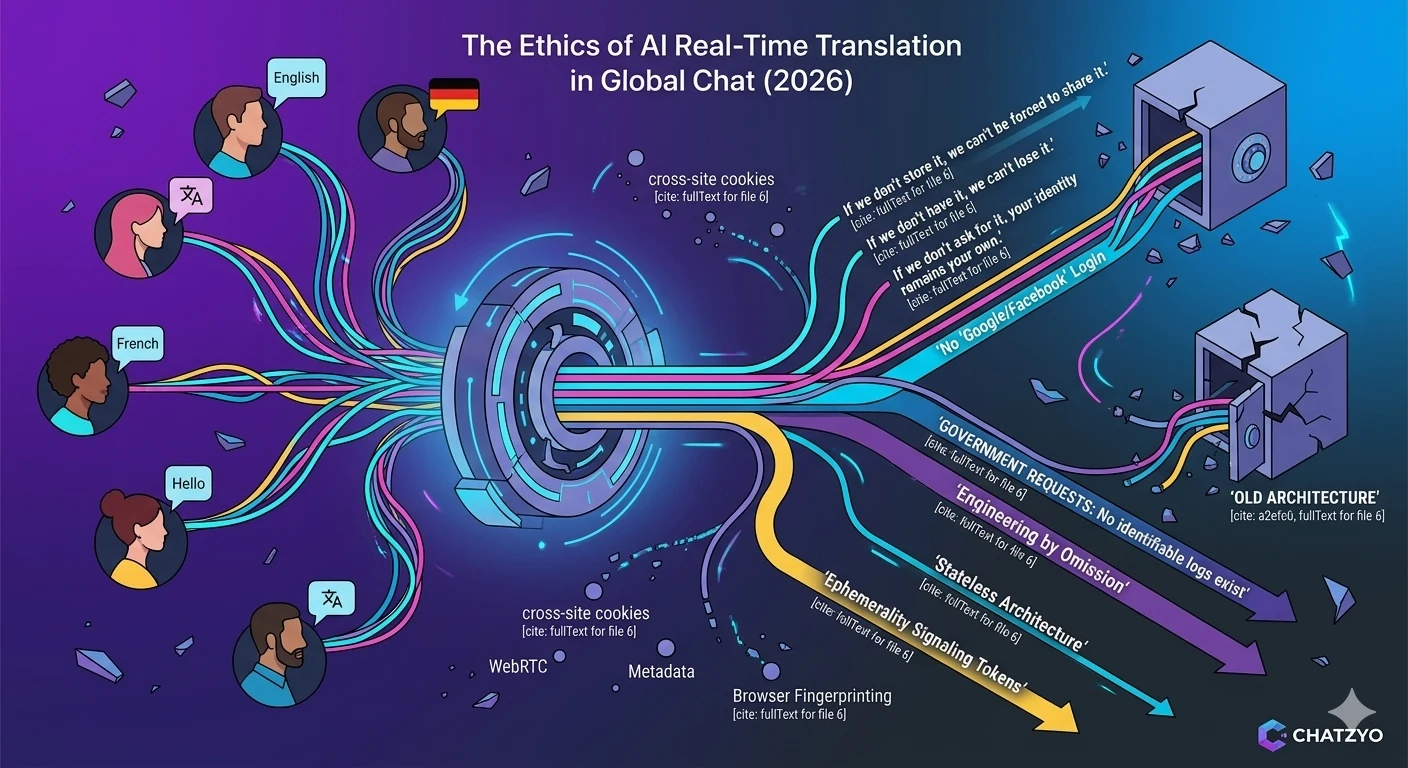
The Ethics of AI Real-Time Translation in Global Chat (2026)
As we navigate the mid-2020s, the "Tower of Babel" moment for the internet has finally arrived. In 2026, AI real-time translation has transformed from a glitchy novelty into a seamless layer of our digital existence. On platforms like CHATZYO, a user in Coimbatore can converse with someone in Berlin as if they shared a native tongue. But as the language barrier falls, a new set of ethical questions rises: What happens to cultural nuance when a machine mediates our words? Is a translated connection truly "human"?
1. The Loss of Cultural Nuance and Untranslatables
Every language carries a world of history and emotion. When an AI translates "Saudade" from Portuguese or "Enthiran" from a futuristic tech context, it often chooses the closest functional equivalent. The danger lies in the "homogenization" of thought. If the AI always rounds off the sharp corners of regional dialects to make them understandable, we lose the very diversity that makes global chat exciting.
In 2026, developers are grappling with "Linguistic Colonization." If translation models are trained primarily on Western datasets, they may inadvertently project Western social norms onto vernacular conversations. At CHATZYO, we believe in preserving the "raw" feel of interaction, which is why we emphasize transparency in our moderation and toolsets.
2. Authenticity vs. Synthetic Fluency
When you use an AI to sound perfectly fluent in a language you don't speak, are you presenting your true self? Synthetic fluency creates a paradox. It allows for immediate connection, but it can also lead to a "hollow" interaction. If the person on the other side falls in love with the translation rather than the person, where does the relationship stand?
3. Data Sovereignty and the Zero-Data Ethics
The technical reality of real-time translation requires a server to "listen" to the input to produce an output. In an era of high-frequency digital scams, the privacy of this middle-layer is paramount. An ethical random video chat platform must ensure that translation data is ephemeral.
Our commitment at CHATZYO is rooted in a random video chat" class="internal-link">zero-data philosophy. We believe that while AI should help you understand a stranger, it should never "remember" what you said. Processing translation on-device (Edge AI) is the ethical frontier we are pushing in 2026 to ensure that your private thoughts remain private.
4. The Impact on Language Learning
There is a growing concern that instant translation will kill the incentive to learn new languages. Why spend years studying Tamil or Spanish if a chip in your ear or a script on your screen does it for you? Ethically, we must position AI as a bridge, not a destination. The most successful users in 2026 use translation to start the journey, eventually picking up phrases and cultural cues that no machine can replicate.
5. FAQ: Navigating the Translated Web
Is AI translation 100% accurate in 2026?
No machine is perfect. While 2026 models are 98% accurate for common phrases, they still struggle with heavy sarcasm, deep metaphors, and rapidly evolving slang.
Does using translation make my chat less "real"?
It depends on your intent. If you use it to find common ground with someone you otherwise couldn't talk to, it’s a tool for empathy. If you use it to deceive, it becomes a barrier to authenticity.
Conclusion: The Human in the Machine
The ethics of AI real-time translation aren't found in the code, but in the people using it. As we build the future of anonymous chat, our goal is to ensure that technology serves as a window to other cultures, not a mirror of our own biases. By prioritizing transparency, privacy, and cultural respect, we can ensure that the global conversation of 2026 is louder, clearer, and more inclusive than ever before.