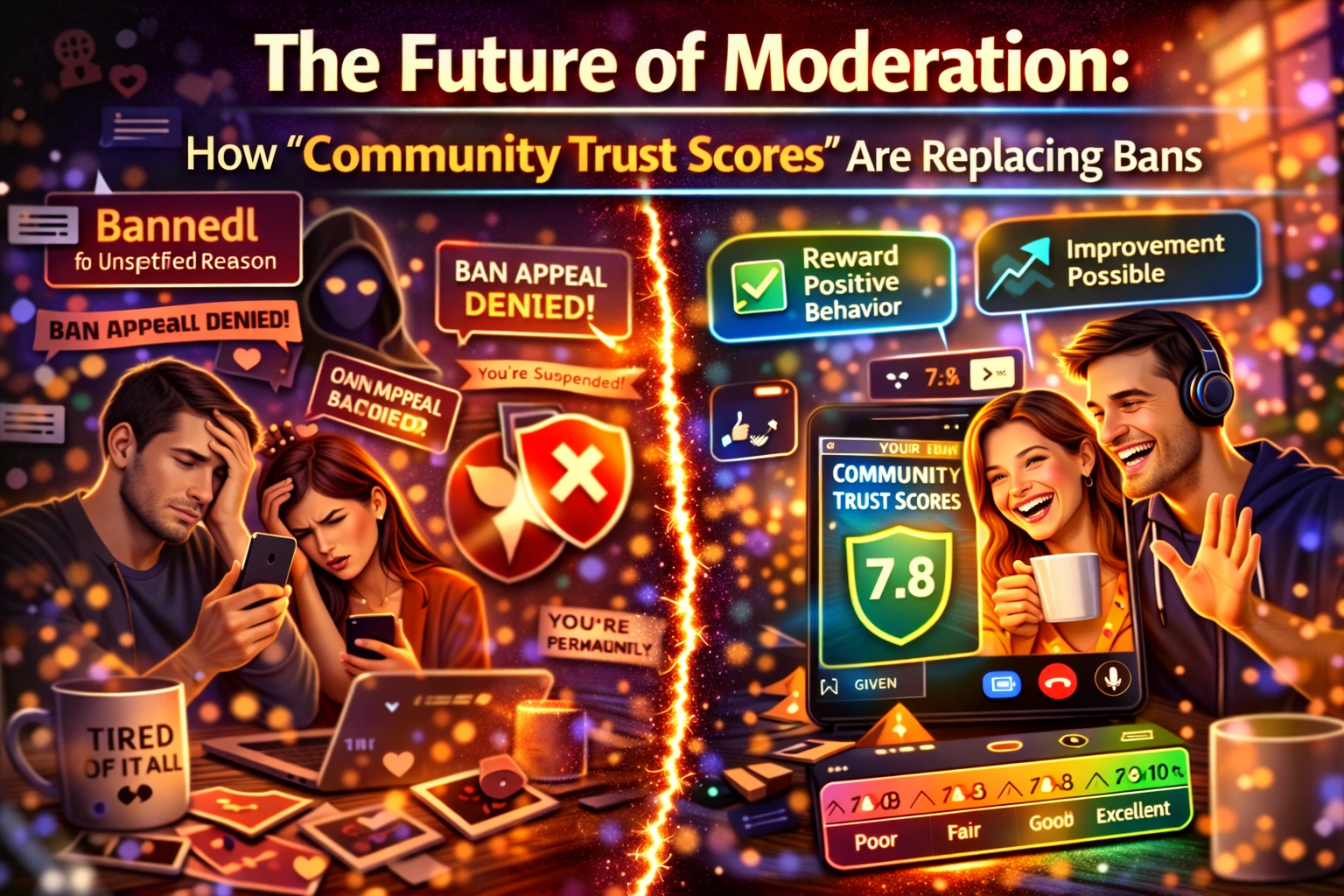
The Future of Moderation: How "Community Trust Scores" Are Replacing Bans
Published by Chatzyo Insights | Niche Interests & Brand Utility
Since the dawn of the public internet, the primary tool for maintaining order in digital communities has been the "Ban Hammer." If a user violated a platform's terms of service, an administrator would identify their account or IP address and permanently sever their access to the site. For decades, this binary system—you are either allowed in, or you are locked out—was the undisputed industry standard for digital moderation.
However, as we analyze the digital safety landscape of 2026, the traditional ban is rapidly becoming obsolete. In modern, high-velocity social discovery platforms, the ban hammer has proven to be a blunt, fundamentally broken instrument. Bad actors easily bypass bans, while legitimate users are increasingly frustrated by heavy-handed, centralized AI moderation that misinterprets context.
The solution emerging across the industry is a shift from punitive, binary moderation to organic, rehabilitative ecosystems. Welcome to the era of the Community Trust Score. In this educational analysis, we will explore why traditional bans fail, how modern trust algorithms work, and how they protect the integrity of 1-on-1 random video chat without invading user privacy.
The Flaws of the Traditional "Ban" Economy
To understand why the industry is shifting, we must examine why the old model collapsed, specifically within the context of the no-login revolution.
Traditional bans rely on two things: persistent user accounts or static IP addresses. If a platform operates on a strict "no-registration" philosophy to protect user privacy, there is no account to ban. The fallback method—banning an IP address—is practically useless in 2026. The widespread adoption of consumer VPNs (Virtual Private Networks), dynamic IP allocation by internet service providers, and mobile network hopping means a malicious user can circumvent an IP ban in under five seconds.
When bad actors realize a ban is merely a five-second inconvenience, the deterrent effect drops to zero. Furthermore, binary banning forces a platform to act as a global police force, making subjective moral judgments on millions of interactions per minute. This model is economically unsustainable and technologically futile.
Cybersecurity experts refer to IP banning as "playing Whack-a-Mole." You ban one proxy, and the user pops up on another. True moderation in Web 3.0 and modern P2P networks requires shifting the focus from identifying the user to evaluating the behavior.
What is a Community Trust Score?
A Community Trust Score replaces the binary "ban" with a sliding scale of reputation. Instead of a central admin deciding who stays and who goes, the community itself implicitly votes on a user's behavior in real-time.
Here is how it functions on modern WebRTC platforms: When you initiate a session, you are assigned a neutral baseline score. Every interaction you have slightly alters that score based on behavioral heuristics.
- Positive Signals: If strangers consistently choose to talk to you for extended periods (e.g., sessions lasting longer than three minutes), your score increases. This indicates you are a conversational, respectful, and engaging participant.
- Negative Signals: If strangers consistently hit the "Skip" button within the first three seconds of seeing your camera feed, or if they utilize the "Report" function, your score plummets rapidly.
How Trust Scores Work in a "Zero-Data" Environment
A common question arises: If there are no accounts, how does a trust score persist?
The brilliance of the 2026 trust score model is that it aligns perfectly with the zero-data philosophy. The score is not attached to a permanent identity; it is attached to an ephemeral session via lightweight browser fingerprinting or encrypted session tokens.
The platform does not need to know your name, email, or exact location. It only needs to know that "Session X" is currently behaving in a toxic manner. This allows platforms to rapidly filter out bad actors while users learn how to talk to strangers safely, all without building a permanent, privacy-invading database of user behavior.
The Moderation Dilemma of WebRTC
Trust scores are particularly vital because of the underlying technology driving modern video chat. As discussed in our overview of the future of WebRTC, these platforms utilize Peer-to-Peer (P2P) architecture. The heavy video and audio data flows directly between the two users, bypassing the central server entirely.
Because the central server literally cannot "see" the video feed (which is a massive privacy benefit), traditional AI video-scanning moderation is impossible. The platform must rely entirely on the behavioral signals (skips, session lengths, manual reports) generated by the users themselves. The Community Trust Score aggregates these signals into a mathematically reliable moderation engine.
Rehabilitative Ecosystems vs. "Shadow Pooling"
So, what happens when a user's trust score drops too low? Instead of issuing a formal ban (which just prompts the user to reset their router and return), the platform employs a technique known as Shadow Pooling or "Quarantining."
High-trust users (those who are engaging, respectful, and actively participating) are mathematically prioritized to match with other high-trust users. This creates an incredibly safe, high-quality discovery pool for the vast majority of the community.
Conversely, users whose scores drop into the negative threshold are seamlessly routed into a secondary matching pool, often without their knowledge. In this shadow pool, toxic users are only matched with other toxic users. They are not banned from the website; their experience is simply degraded based on their own behavior. If they wish to re-enter the high-trust pool, they must earn their way back through positive interactions, creating a rehabilitative ecosystem rather than a punitive one.
Conclusion: Empowering the User
The shift from central administrative bans to Community Trust Scores represents a fundamental democratization of digital safety. It transfers the power of moderation from an opaque corporate algorithm back into the hands of the community.
By understanding and leveraging these behavioral signals, modern platforms can maintain the frictionless, spontaneous joy of random video discovery while effectively insulating their user base from the privacy risks and toxic elements of anonymous chat. The future of moderation is not about building taller walls; it is about cultivating a smarter, self-healing ecosystem.
Frequently Asked Questions
A Community Trust Score is a dynamic, algorithmic rating assigned to a user's current session based on peer behavior. It evaluates factors such as how long strangers choose to talk to them, how often they are skipped immediately upon connecting, and manual user reports. This score dictates the quality of their future matches.
In a friction-less, no-login environment, banning an IP address is largely futile because bad actors can easily use consumer VPNs or dynamic IPs to circumvent the ban in seconds. Bans are a binary Web 2.0 tool that fails against modern anonymous, highly fluid network architectures.
Trust scores utilize ephemeral device fingerprinting and session-based heuristics. The score is tied strictly to the active browser session, maintaining a zero-data privacy philosophy while ensuring community safety in real-time. Once the session terminates or the user leaves, the slate is wiped clean.
If a trust score drops due to toxic behavior, terms of service violations, or frequent immediate skips by peers, the user is seamlessly moved into a "shadow pool" or quarantine tier. In this tier, they will primarily only match with other low-score users, protecting the broader, high-trust ecosystem without issuing a formal, easily bypassed ban.