How Real-Time Chat Platforms Prevent Abuse Without Breaking Privacy
The technical paradox of 2026: Building a safe community while maintaining a 'Zero-Data' promise.
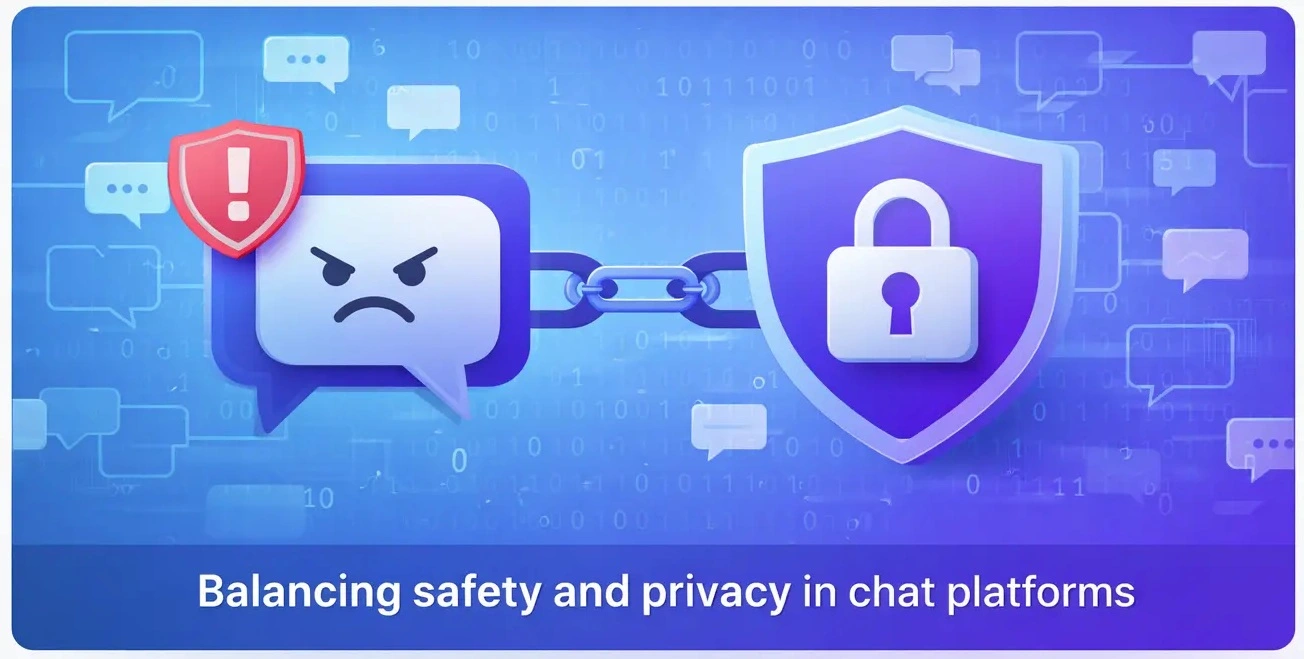
In the digital landscape of 2026, we face a fundamental paradox. Users demand absolute anonymity and privacy—the right to speak freely without being tracked, logged, or analyzed. Simultaneously, the internet remains a breeding ground for harassment, spam, and malicious behavior. For most platforms, the solution is simple: surveillance. They read your messages to "protect" you.
As we explained in our analysis of the hidden privacy risks of anonymous chat platforms, anonymity at the interface level does not always mean anonymity at the infrastructure level.
But at CHATZYO, we believe that security should never come at the cost of your civil liberties. We ask a different question: How can we stop the bad actors without ever knowing who the good actors are?
This article explores the cutting-edge engineering behind Stateless Moderation, the role of WebRTC encryption, and why "Zero-Data" isn't just a marketing slogan—it's a superior security model.
The Evolution of Modern Abuse
To understand the solution, we must first understand the threats. In 2026, abuse on real-time chat platforms has evolved beyond simple "bad words." Today, we deal with:
In our complete safety analysis of anonymous chat rooms in 2026, we outlined how abuse patterns have evolved beyond simple content violations into behavioral manipulation.
- AI-Generated Spam: Bots that can mimic human conversation to spread phishing links.
- Digital Harassment: Coordinated efforts to disrupt public chat rooms.
- Deepfake Audio: Misusing voice chat features to impersonate others.
Users who cite "Privacy" as their top concern in 2026.
Increase in AI-driven spam since 2024.
1. The Foundation: Peer-to-Peer Privacy
The traditional way to prevent abuse is to route all messages through a central server. The server scans the message, checks it against a "blacklist," and then sends it to the recipient. This is known as a **Client-Server-Client** model. The problem? The server has a copy of your private conversation.
WebRTC and E2EE
At Chatzyo, we utilize WebRTC (Web Real-Time Communication). As we discussed in our WebRTC Tech Guide, this technology allows data to flow directly between browsers. By the time a message is sent, it is already encrypted. This means that even if a hacker (or the platform itself) tried to intercept the data, they would see nothing but gibberish.
But if the platform can't read the message, how can it stop a harasser? The answer lies in Metadata Analysis and Client-Side Intelligence.
2. Stateless Moderation: Detecting Patterns, Not Content
Stateless moderation is the "holy grail" of privacy-centric engineering. It focuses on behavioral patterns rather than the content of the chat.
By using Machine Learning at the Edge, we can identify these patterns. The detection happens on the "edge" (the user's browser or the entry point), preventing the abuse from reaching the community while the central database remains "blind" to the actual conversation content.
3. The "Zero-Data" Safety Net
Many people assume that keeping more data makes a platform safer. The reality is the opposite. Data is a liability. If a platform keeps logs of every user's IP, location, and chat history, that data eventually becomes a target for hackers.
Why No-Login is Safer
By removing the login requirement, Chatzyo eliminates the most common vector for abuse: Account Takeovers. There is no password to steal, no email to leak, and no profile to stalk. Each session is ephemeral—it exists only for the moment. This "Stateless Architecture" ensures that even if a user is blocked for abuse, they have no personal data stored on our servers to exploit later.
4. Regional Nuance: Privacy in Tamil & Hindi Communities
Abuse often hides in language. A filter that works for English might miss harmful slang in Tamil or Hindi. At Chatzyo, we are building Vernacular Moderation Engines that respect cultural context without infringing on privacy.
Instead of a global "Big Brother" watching everything, we empower the community. Our **Real-Time Reporting System** allows users to flag behavior. Because we use WebRTC, these reports include a cryptographic proof of the interaction, allowing our AI to verify the abuse without needing access to the user’s entire chat history.
5. The Future: AI-Human Hybrid Moderation
As we move further into 2026, the human element remains vital. AI can catch the "low-hanging fruit" of spam and bots, but human moderators understand nuance. The challenge is protecting the privacy of the users while a human reviews a report.
We use Differentially Private Reporting. When a user is reported, the moderator only sees the specific snippet of the interaction required to make a decision. The rest of the user’s digital footprint remains locked and encrypted.
Frequently Asked Questions
How can chat platforms prevent abuse without reading messages?
Modern privacy-first platforms use behavioral pattern detection instead of content surveillance. By analyzing metadata such as message frequency, repetition patterns, and session activity, platforms can detect spam or coordinated abuse without accessing the actual message content.
What is stateless moderation?
Stateless moderation is a privacy-centric approach where platforms do not store long-term user identities or chat histories. Instead of tracking accounts, the system evaluates real-time behavior patterns to detect abuse, reducing the need for persistent data storage.
Does WebRTC improve privacy in chat platforms?
Yes. WebRTC enables peer-to-peer encrypted communication between browsers. This reduces reliance on centralized servers and ensures that conversations are encrypted before transmission, limiting the platform’s ability to access message content.
Is zero-data architecture safer than traditional moderation systems?
Zero-data architectures reduce risk by minimizing stored user information. Because less data is retained, there is less information exposed in the event of a breach. However, these systems require advanced behavioral detection models to maintain community safety.
Can AI moderate chats without invading privacy?
AI can detect abuse signals by identifying behavioral anomalies rather than scanning message content. When implemented responsibly, machine learning systems can prevent spam and harassment while maintaining user anonymity.
Conclusion: The Chatzyo Manifesto
Privacy is not a luxury; it is a right. Safety is not an excuse for surveillance; it is a responsibility. Real-time chat platforms in 2026 must prove they can do both. By leveraging WebRTC, stateless moderation, and a relentless commitment to "Zero-Data," Chatzyo is proving that the safest place to talk is the place that knows the least about you.