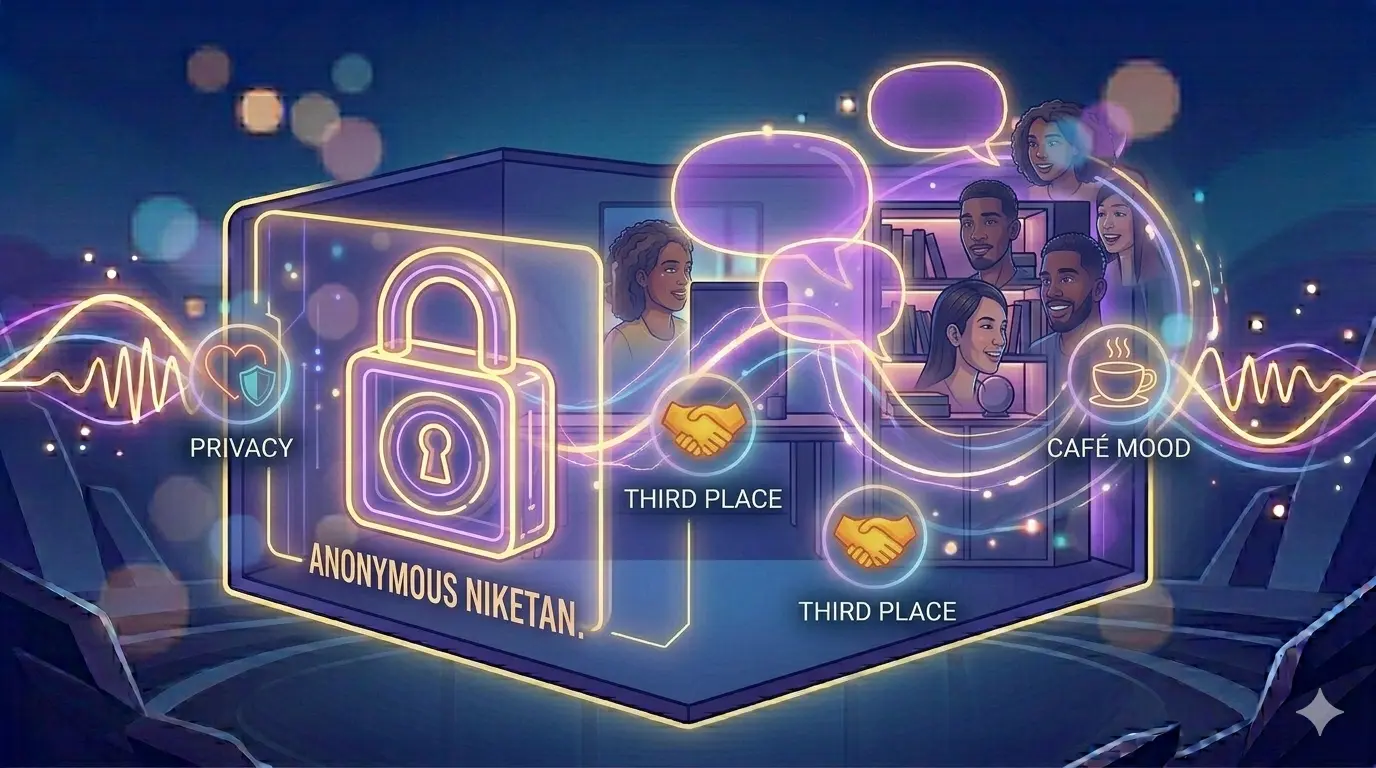
Reclaiming the "Third Place": How Anonymous Sites Are Replacing Physical Cafés
In 1989, urban sociologist Ray Oldenburg published a deeply influential book called The Great Good Place. In it, he coined the term "The Third Place." According to Oldenburg, your "First Place" is your home. Your "Second Place" is your workplace or school. The "Third Place" is the communal anchor of community life—a public setting where people can gather, put aside their concerns, and simply interact. Historically, these were local pubs, civic centers, barbershops, and neighborhood cafés.
A true Third Place is defined by a few strict characteristics: it is highly accessible, it has a leveling effect (social status doesn't matter inside), conversation is the primary activity, and it is full of "regulars" alongside total strangers. But as we navigate life in 2026, the physical Third Place is vanishing. A combination of soaring commercial real estate costs, the normalization of remote work, and the hyper-commercialization of café spaces has hollowed out local community hubs. Where do we go when we just want to casually exist around other human beings?
The answer is not found on traditional social media, which failed spectacularly to recreate community. Instead, we are seeing a massive migration toward an unexpected sanctuary: random video chat platforms.
The Failure of Web 2.0 Social Media as a "Lounge"
For a long time, tech giants promised us that social networks would be the new digital town square. We were told our newsfeeds would serve as the ultimate Third Place. We now know this was a fundamentally flawed premise.
Traditional social media platforms are not lounges; they are performance stages. You do not casually hang out on an algorithmic timeline; you perform for likes, curate a personal brand, and argue in comment sections optimized for outrage. As we explored in our analysis of the Post-Algorithm Era, these platforms are too heavily monitored, tracked, and monetized to allow for the relaxed serendipity required of a true community space.
Oldenburg stated that in a true Third Place, "the joy of association" is the ultimate goal. When every digital interaction you have is tied to a permanent profile, a follower count, and a curated aesthetic, the joy of association is replaced by the anxiety of perception.
The Restorative Power of Anonymity
Think back to the magic of a bustling 1990s coffee shop or diner. When you walked through the door and sat at the counter, you didn't wear a nametag detailing your job title, your relationship status, and your entire political history. To the stranger sitting two stools down, you were a blank slate. You were anonymous.
This anonymity is the secret ingredient of the Third Place. It is the great social leveler. It allows people from vastly different socioeconomic backgrounds to strike up a conversation based purely on the immediate, shared human experience of being in the same room.
This is precisely why Chatzyo operates on a strict Ghost Architecture. By refusing to harvest personal data and eliminating the need for logins or profiles, we restore the blank slate. When you engage in a 1-on-1 video call, you are stripped of your digital baggage. You are no longer your job title; you are just a voice, a face, and a mind. It is the exact sociological leveling effect that Oldenburg described.
Flexing in the "Social Gym"
The evaporation of physical Third Places has had a devastating effect on our collective social skills. Many young adults today report immense anxiety at the thought of initiating a conversation with a stranger in public because they simply have no place to practice.
Anonymous peer-to-peer video chat serves as a vital Social Gym. It provides the low-stakes environment necessary for exposure therapy. Because the interactions are ephemeral, the fear of lasting rejection is minimized. Users can log on, practice maintaining eye contact, work on asking open-ended questions, and build their conversational resilience. It is a space to make mistakes, learn how humans tick, and slowly rebuild the spontaneous social confidence that modern life has eroded.
The Global Lounge with a Local Feel
While the accessibility of the internet means your Third Place is global, it doesn't have to be overwhelmingly vast. Just as a physical city has different neighborhoods, the digital Third Place has different rooms.
The rise of regional hubs has allowed users to find their specific tribe within the global network. A user in Chennai might frequent the Tamil chat rooms to find the comforting familiarity of their native tongue and hyper-local humor, while later jumping into a USA chat room to expand their worldview. It is the digital equivalent of choosing between your cozy neighborhood pub and a bustling international airport lounge, depending entirely on your mood.
Frequently Asked Questions
It is not about absolute replacement; it is about providing an accessible alternative. Physical community is ideal, but when it is economically or geographically inaccessible, a zero-latency, high-definition video connection provides a deeply vital, secondary layer of human connection that text-based apps cannot match.
While the platform is anonymous by default, the beauty of the Third Place is that if you find a connection you truly value, you have the autonomy to take it off-platform. The digital café is the starting point of serendipity, not necessarily the ending point.
Conclusion: Rebuilding the Great Good Place
We are social creatures living in an increasingly isolated infrastructure. The physical spaces that used to effortlessly weave our communities together are fading. However, human ingenuity always finds a way to fulfill its deepest needs. By leveraging real-time WebRTC technology and stripping away the toxic performance metrics of Web 2.0, anonymous video platforms are achieving something profound. They are taking the psychological safety, the anonymity, and the unscripted joy of the traditional Third Place and making it accessible to anyone with an internet connection. The café hasn't died; it has simply moved online.