The Science of Anonymity: Why We Talk Better to Strangers Online
Have you ever found yourself telling a complete stranger on a 10-minute train ride something you’ve never told your best friend? Or perhaps, while using an anonymous chat platforms like random video chat, you’ve shared a deep-seated fear or a hidden ambition that you keep locked away in your "real" life? You aren't alone. This phenomenon is rooted in deep psychological drivers that have only intensified in the digital landscape of 2026.
Today millions of people use the internet to talk to strangers online through anonymous chat rooms and random video chat platforms. After the shutdown of Omegle, many users are searching for safer ways to connect with new people without sharing personal information.
In this deep dive, we explore the Online Disinhibition Effect, the "Stranger-on-a-Train" phenomenon, and why anonymous environments like Chatzyo often foster more meaningful connections than traditional, profile-based social media.
1. The "Stranger-on-a-Train" Phenomenon
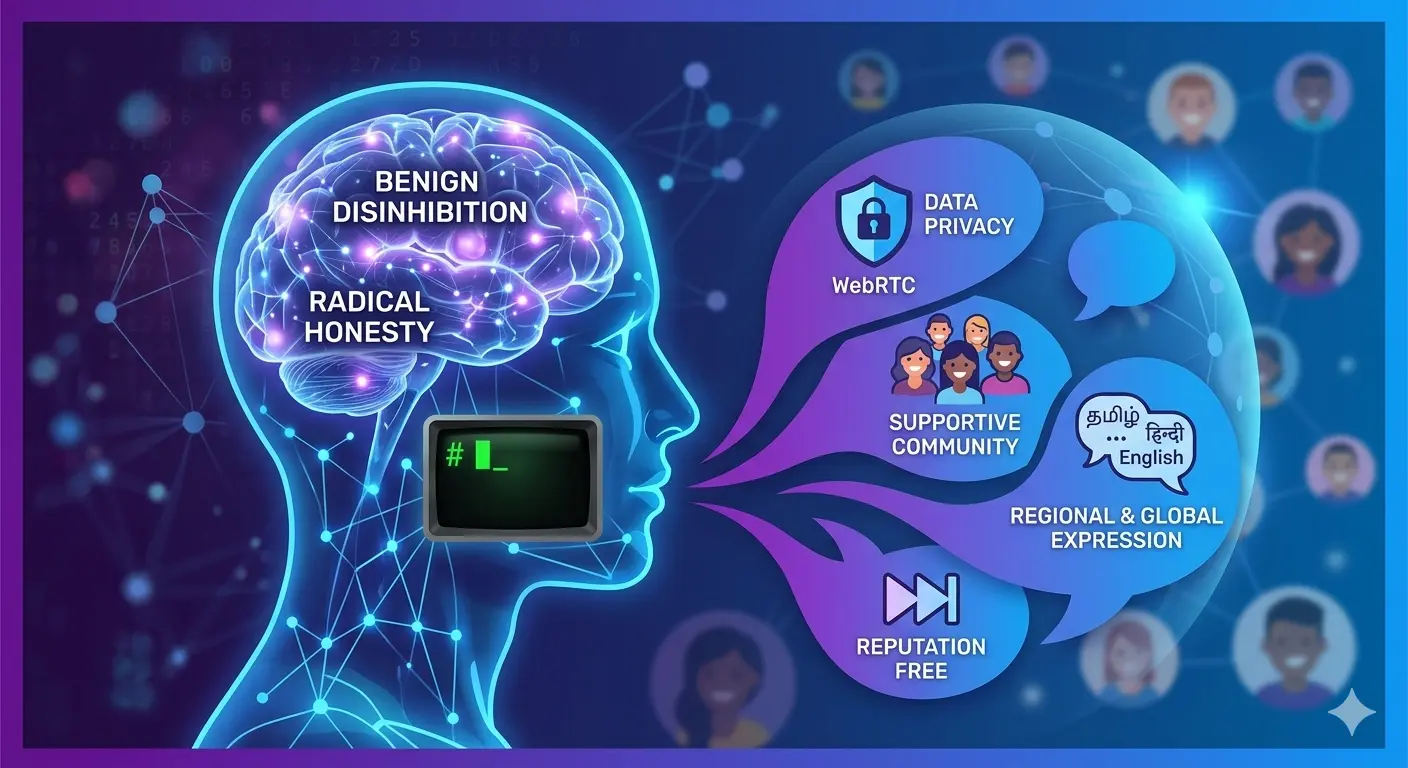
Psychologists have long studied why humans feel a sudden burst of honesty when talking to someone they will likely never see again. Known as the "Stranger-on-a-Train" effect, it occurs because the social "cost" of judgment is removed. When we talk to friends or family, we are constantly managing our reputation. We worry about how our words will affect our long-term relationships.
With a stranger, there is no past and no future—only the present moment. This lack of consequence allows for radical honesty. In 2026, as social media becomes a permanent record of our lives, the need for these transient, "consequence-free" spaces has become a vital part of mental well-being.
2. Understanding the Online Disinhibition Effect
Coined by psychologist John Suler, the Online Disinhibition Effect explains why people behave differently online than in person. There are two types of disinhibition:
Toxic Disinhibition
This is the dark side of anonymity—trolling, cyberbullying, and aggressive behavior. Because the person cannot see the physical reaction of their partner, they lose the "empathy brake" that normally stops them from being rude. This is why robust moderation is essential for any modern chat platform.
Benign Disinhibition
This is the "secret sauce" of positive online interaction. It is when people use anonymity to share personal feelings, practice new languages, or seek emotional support. Benign disinhibition allows a shy person to become charismatic or a burdened person to find catharsis.
3. The Architecture of Anonymity: Why Identity-Less Chat Wins
Most modern social platforms are built on "Personal Branding." You have a profile, a photo, and a history. This creates a "Performance Anxiety." You aren't just talking; you are maintaining a brand.
Anonymous chat rooms strip this away. By removing the profile, you remove the performance. This technical choice is what we call Zero-Data Philosophy. When a platform doesn't ask for your name or email, it is giving you a psychological "blank slate." As we noted in our history of online chat rooms, the shift from text-only IRC to video has only heightened the need for privacy-preserving technology like WebRTC.
4. Breaking the Language Barrier: Anonymity in Regional Communities
For users in linguistically diverse regions like India, anonymity plays a unique role. Many people feel "shame" or "judgment" when practicing a new language or using their native vernacular (like Tamil, Hindi, or Telugu) in professional or global spaces.
Anonymous spaces allow users to "fail" without embarrassment. You can join a Tamilan chat room and speak freely, making mistakes and learning in real-time. This is why learning how to talk to strangers is becoming a key digital skill for the 2020s.
5. The Role of Anonymity in Mental Health and Loneliness
Loneliness is the silent epidemic of 2026. Paradoxically, the more "connected" we are through traditional apps, the lonelier we feel because those connections are often shallow and performance-based.
Anonymous chat offers "Micro-Connections." Even a 5-minute conversation with a stranger about a shared interest in movies or music can trigger a dopamine release and reduce the feeling of isolation. It provides the "low-stakes" social friction that humans evolved to thrive on, but which modern life has largely removed.
Frequently Asked Questions
Is talking to strangers online actually good for you?
Yes, when done safely. It can improve social skills, reduce social anxiety, and provide a fresh
perspective that friends and family cannot offer.
How can I stay safe while being honest?
Never share Personally Identifiable Information (PII) like your home address, workplace, or bank
details. Benign disinhibition should be about sharing thoughts and ideas, not sensitive data.
Quick Summary
- Anonymity reduces social pressure and encourages honest conversations.
- The “Stranger-on-a-Train” effect explains why people open up to strangers.
- Online Disinhibition allows people to express thoughts more freely.
- Anonymous chat platforms create low-pressure environments for social interaction.
- Safe moderation ensures anonymity remains positive rather than toxic.
Final Thoughts: The Future of Digital Honesty
The science is clear: Anonymity is a tool. In the right hands, it is a bridge to authentic connection. In the wrong hands, it is a shield for toxicity. As we move further into 2026, the platforms that succeed will be the ones that harness Benign Disinhibition while aggressively filtering out the toxic.
At Chatzyo, we build for the person who wants to be heard, not just seen. Whether you are seeking a global perspective or a local friend in your regional language, remember that the person on the other side is just as human as you are—and they are likely looking for the same thing: a moment of real connection in a digital world.