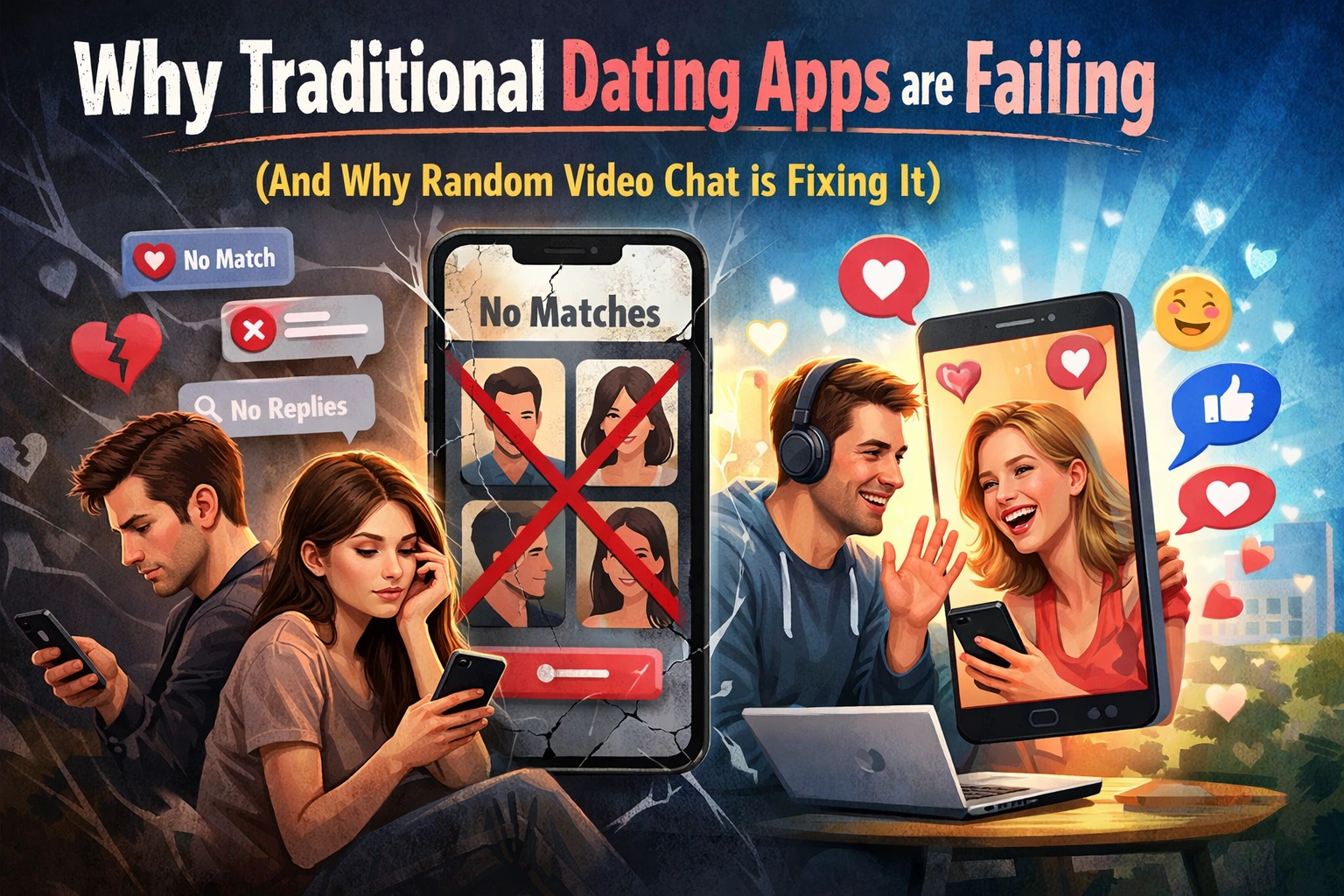
Why Traditional Dating Apps are Failing (And Why Random Video Chat is Fixing It)
Published by Chatzyo Insights | Educational & Market Analysis
For the better part of the last decade, the global social discovery market was monopolized by a single, distinct user interface: the "swipe." Pioneered by Tinder in 2012, gamified dating applications revolutionized how humans connect, turning courtship into an endless deck of digital trading cards. However, as we analyze the market data in 2026, a profound correction is taking place. Growth for major swipe-based applications has stagnated, user churn is at an all-time high, and market sentiment has turned incredibly sour.
Millions of users are abandoning the heavily curated, algorithmic profiles of traditional matchmaking apps and migrating toward the raw, unscripted authenticity of random video chat platforms. To understand this massive digital migration, we must examine the psychological burnout of the swipe era, the exploitative nature of algorithmic paywalls, and how Peer-to-Peer (P2P) video technology is finally restoring genuine human connection to the internet.
The Psychology of "Swipe Fatigue" and Gamification
Traditional dating apps were not designed by sociologists optimizing for successful relationships; they were designed by software engineers optimizing for retention. The core mechanic—the swipe—is built upon a psychological principle known as the "variable ratio schedule of reinforcement." This is the exact same behavioral psychology that powers slot machines in casinos. You keep swiping because the next profile *might* be the perfect match.
While highly addictive in the short term, this gamification ultimately leads to profound digital fatigue. Users spend hours engaging in low-intent swiping, followed by exhausting, performative text messaging that rarely translates into a real-world connection. The human brain is not wired to process hundreds of potential romantic or social connections in a single sitting. The result is a paradox of choice: when presented with infinite options, users become paralyzed, dissatisfied, and emotionally burnt out.
Dating apps commodify human beings, creating an illusion of infinite supply. This encourages a "disposable" mindset where users abandon promising conversations at the first sign of friction, believing someone better is just one swipe away. This fundamentally undermines the patience required for genuine social discovery.
The Algorithmic Paywall: Monetizing Loneliness
As traditional apps transitioned from growth phases to revenue generation, their internal algorithms changed drastically. Platforms began implementing aggressive "freemium" models that effectively hid the most compatible profiles behind steep paywalls.
If you want to see who liked you, you must pay $20 a month. If you want your profile shown to more people in your area, you must buy "boosts." The algorithm no longer serves the user's best interest; it serves the shareholders. This has created a deep sense of resentment among users who feel that their digital social lives are being actively suppressed to extract subscription fees.
This frustration is the primary driver pushing users toward the post-algorithm era of socializing. Random video chat platforms operate on chaotic serendipity. There is no algorithm analyzing your "attractiveness score" and hiding you from other users. When you enter a P2P discovery portal, the matching is truly random and instantaneous. It is a level playing field completely devoid of pay-to-win mechanics.
The Authenticity Crisis: Catfishing and AI Generation
Perhaps the most critical failure of traditional text-and-photo apps is the "Authenticity Crisis." A curated profile is rarely an accurate representation of a human being. Users naturally upload photos from five years ago, heavily edit their appearances, and write biographies that project an idealized version of themselves.
Furthermore, with the explosion of generative AI in recent years, it has become incredibly easy to automate fake profiles and script chatbot responses, leading to widespread "catfishing" and financial scams. Trust in digital profiles is at an all-time low.
This is precisely where WebRTC-based 1-on-1 video connections present an insurmountable advantage. Live video is the ultimate authenticity filter. When you connect with someone via their device's camera and microphone in real-time, deception becomes practically impossible. You hear their real voice, you see their real environment, and you assess their micro-expressions instantaneously. The chemistry—or lack thereof—is established in the first three seconds, saving users weeks of wasted text messaging.
The Hidden Cost: Data Harvesting and Privacy Violations
To function effectively, traditional swipe applications require the most sensitive data a consumer can provide. Users willingly hand over their precise GPS locations, their sexual preferences, their religious and political affiliations, and complete logs of their most intimate text conversations. In the hands of massive tech conglomerates, this "Digital Dossier" is aggregated, analyzed, and frequently sold to third-party data brokers to serve targeted advertisements.
In contrast, modern WebRTC discovery platforms operate on a strict zero-data philosophy. These platforms are increasingly adopting "no-login" architectures. When you click "Start Chat," the browser creates a temporary, encrypted peer-to-peer connection directly with another user.
Because there is no account creation, no password, and no email verification, there is no permanent database record of the interaction. For users who value their digital sovereignty and wish to stay anonymous while video chatting, this ephemeral architecture provides absolute peace of mind. When the browser tab is closed, the connection vanishes without a trace.
Conclusion: The Return to Spontaneous Humanity
The failure of traditional dating and networking applications was not a failure of the users; it was a structural failure of the medium. Text and static images simply do not contain enough bandwidth to convey the complexities of human chemistry. Furthermore, forcing that limited medium through aggressive algorithmic paywalls and data-harvesting schemes ultimately broke user trust.
The explosive resurgence of random video chat powered by WebRTC P2P communication is a market correction. It represents a collective desire to return to the spontaneity of real-world interaction. By stripping away the curated profiles, the subscription tiers, and the algorithms, these platforms are reminding the internet of a fundamental truth: the most exciting connections are the ones you never could have planned for.
Frequently Asked Questions
Dating app fatigue is caused by a combination of factors: the psychological exhaustion of the "swipe" gamification mechanic, the frustration of communicating with heavily curated or deceptive profiles, algorithmic paywalls that intentionally hide compatible users to force upgrades, and the draining nature of maintaining prolonged, low-intent text conversations.
Random video chat connects users face-to-face in real-time. Because the interaction happens live via a device's camera and microphone, it bypasses the ability to use old photographs, heavily edited static profiles, or AI-generated images to deceive the other person. You see exactly who you are talking to immediately.
Traditional dating and matching apps require users to build a permanent, centralized "digital dossier" containing highly sensitive personal data, exact GPS locations, and permanent text logs. WebRTC "no-login" platforms process video directly between peers (P2P). Because there is no user account to tie the data to, there is no permanent database record left behind once the browser tab is closed, ensuring true privacy. However, users should always practice safe chatting protocols during the live session itself.