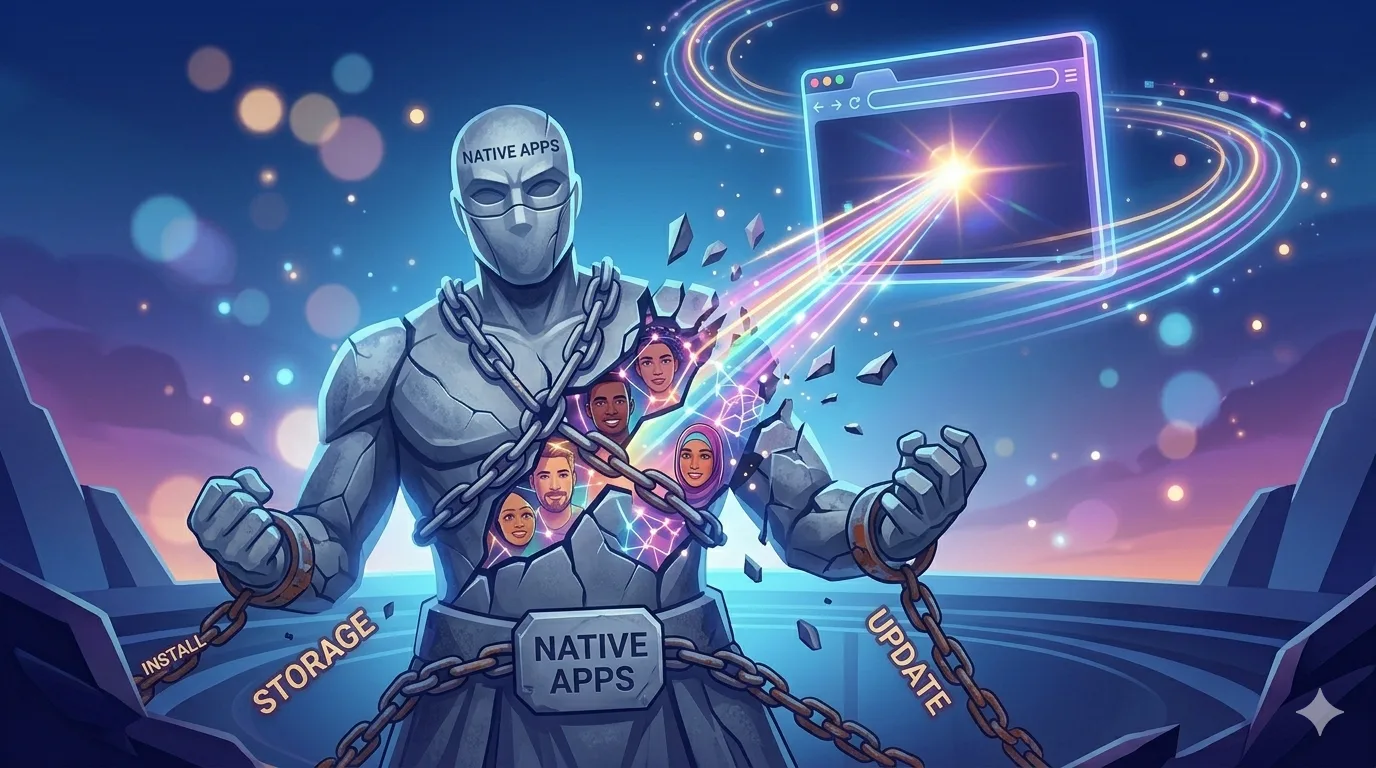
Why Browser-Based Video is Winning the War Against "Heavy" Native Apps
For the better part of the last decade, the technology industry operated under a single, unshakeable mantra: "There's an app for that." Companies spent millions trying to force users out of mobile browsers and into the iOS App Store or Google Play Store. The logic was simple: apps offered better performance, native hardware access, and most importantly, push notifications to command user attention.
But in 2026, a massive paradigm shift is occurring, particularly in the realm of random video chat and social discovery. Users are actively rebelling against native applications. We are currently experiencing peak "App Fatigue." Instead, the market is aggressively shifting back to where it all began: the web browser. Thanks to the monumental advancements in WebRTC (Web Real-Time Communication), browser-based video isn't just catching up to native apps—it is thoroughly defeating them.
The Crisis of "App Fatigue" and Storage Anxiety
To understand the shift, we have to examine the bloated state of modern native applications. A standard social networking app today can easily consume 500MB to 1GB of storage space. For users in emerging markets, or those using mid-range Android devices, this "Storage Anxiety" is a daily reality. Before a user can even try a new native chat app, they have to calculate which photos or older apps they must delete to make room.
Furthermore, native apps are notorious for running heavy background processes. They constantly ping location servers, refresh data, and listen for push notifications, aggressively draining battery life. By contrast, a 1-on-1 video call conducted through a modern mobile browser uses virtually zero permanent storage. When you close the tab on Chatzyo, the background processes die immediately. You reclaim your device's memory, your battery, and your digital peace of mind.
The Technical Marvel of WebRTC
The death of the native chat app would not be possible without WebRTC. In the early days of the internet, browser video required clunky, insecure plugins like Adobe Flash. Today, WebRTC is natively built into Chrome, Safari, Edge, and Firefox. It is an open-source project that provides web browsers with Real-Time Communications capabilities via simple JavaScript APIs.
When you enter USA chat or any other room on our platform, WebRTC bypasses traditional server routing where possible. Instead of sending your video feed to a central server which then forwards it to your partner (a process that inherently causes lag), WebRTC negotiates a direct Peer-to-Peer (P2P) connection. Your browser talks directly to the stranger's browser.
This direct pipeline drastically reduces latency, making conversations feel as instantaneous as if you were in the same room. It is the core technology that allows the browser to outperform the speed of many heavy native apps that rely on older, centralized client-server architectures.
Privacy by Design: The Browser Sandbox
One of the most compelling reasons users are abandoning native social apps is the growing awareness of data privacy. When you install a native app, you are often strong-armed into granting systemic permissions: access to your contact book, your exact GPS location, your camera roll, and your unique device identifier.
Browser tabs operate inside a "Sandbox." This is a critical security mechanism that isolates the website from the rest of your phone’s operating system. When you use an anonymous digital platform through your browser, the site must explicitly ask for microphone and camera permission every time, and it has absolutely zero access to your contacts or hard drive.
At Chatzyo, we view the browser sandbox not as a limitation, but as our greatest feature. It guarantees the promise of our zero-data retention policy. Because we don't force an app download, we mathematically cannot scrape your phone's background data. We offer purely ephemeral connections. You appear, you connect, and when the tab is closed, you vanish without a trace.
Democratizing Global Connections
The "heavy app" model is inherently elitist. It assumes the user has access to cheap broadband for massive downloads and a flagship smartphone with infinite storage. If the goal is to build global empathy and connect disparate cultures, the technology must be democratized.
Browser-based WebRTC democratizes social discovery. It works flawlessly on a $1,000 iPhone in New York, and it works just as well on a $150 Android device connecting via 4G in a Tamil chat room. All that is required is a standard, updated mobile browser. By eliminating the App Store gatekeepers, we ensure that the global conversation is open to anyone with an internet connection, regardless of their hardware tier.
Frequently Asked Questions About Browser Video
No. Modern WebRTC utilizes dynamic resolution scaling. It assesses your network connection in real-time and adjusts the video codec (like VP8 or H.264) to provide the highest possible quality without buffering, often matching or exceeding native app clarity.
While any video processing uses battery, WebRTC in the browser is highly optimized by Google and Apple to use hardware acceleration. Furthermore, because there are no background data-mining processes running (unlike native apps), the overall battery consumption per session is often much lower.
Data and retention. Native apps allow companies to send you push notifications to pull you back in, and they provide far more harvestable user data to sell to advertisers. Chatzyo remains browser-based because we prioritize your autonomy and privacy over data harvesting.
Conclusion: The Future is App-Less
As we look toward the remainder of the decade, the concept of downloading a specific piece of software just to have a conversation will seem as antiquated as using a dial-up modem. The browser has evolved from a simple document viewer into a powerful, secure, and lightning-fast operating system of its own. By leveraging WebRTC, we are tearing down the walled gardens of the App Stores and returning the internet to its original promise: instant, frictionless, and universally accessible human connection.