Cultural Myth-Busting: How Talking to Strangers Challenges Our Geopolitical Biases
We are constantly fed a narrative about "the other." Whether through 24-hour news cycles, algorithmically manipulated social media feeds, or geopolitical posturing, the media often paints foreign nations—and their citizens—in broad, monolithic strokes. These narratives are designed to oversimplify complex global dynamics, resulting in deeply ingrained cultural myths and geopolitical biases.
But what happens when you bypass the media filters entirely? What happens when you use a random video chat platform to bypass state narratives and speak directly to a citizen of a foreign country? You engage in an act of "Citizen Diplomacy." This unfiltered, 1-on-1 communication is proving to be one of the most effective tools for dismantling stereotypes in the digital age.
The Danger of a Single Story
Author Chimamanda Ngozi Adichie famously warned against "the danger of a single story." If we only ever hear one narrative about a group of people, we inevitably view them as one-dimensional caricatures. For decades, traditional media had a monopoly on these stories. If you lived in the United States, your view of the Middle East, Eastern Europe, or South Asia was heavily curated by what broadcasters chose to show.
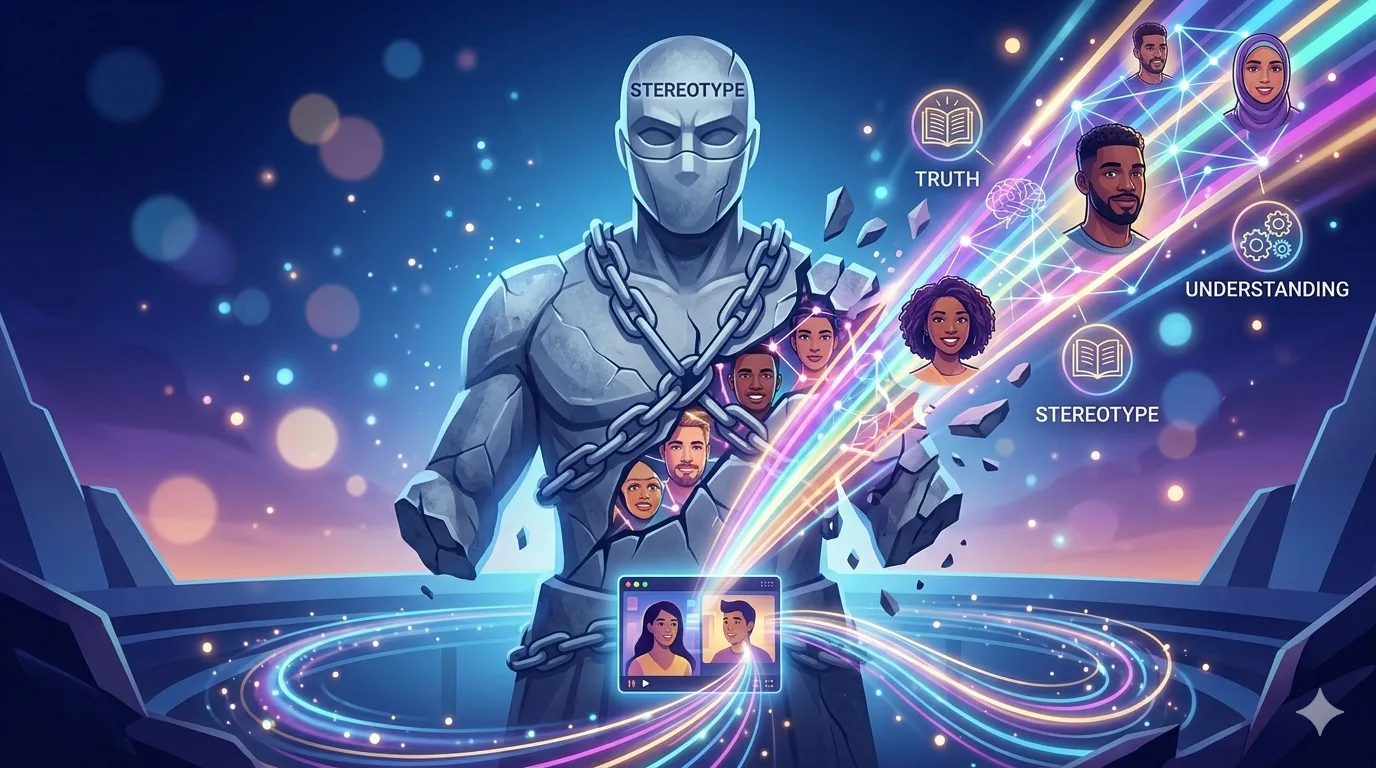
Spontaneous social discovery shatters that monopoly. When a user logs onto USA chat and connects randomly with someone in the UK, India, or Brazil, the "single story" shatters into a million distinct, human realities. You don't meet a "demographic"; you meet a person.
Why Anonymous Chat Fulfills the "Equal Status" Rule
Allport noted that if two groups interact but one holds all the power, prejudice actually increases. For contact to build empathy, the interaction must happen on an even playing field.
In the physical world, power dynamics are everywhere (wealth, geographic location, social class). But in an anonymous digital space, those dynamics are instantly leveled. When two people connect on a 1-on-1 video call, they both control exactly half the screen. They both have the exact same power to initiate, speak, or click the "Next" button. This perfect digital symmetry creates the ideal psychological environment for unbiased cultural exchange.
Busting the "Us vs. Them" Myth
The most pervasive geopolitical bias is the "Us vs. Them" mentality—the belief that people in foreign nations have fundamentally different values, desires, and emotional lives. Random video chat brutally exposes this as a myth through shared mundane realities.
Consider a connection between a user in a regional Tamil chat room and someone in London. The media might focus on vast economic or political differences between the two regions. However, within five minutes of talking, they usually discover they are both stressed about inflation, annoyed by their local traffic, anxious about their careers, and passionate about their favorite sports teams. The realization that human daily struggles are universally identical creates a profound sense of global empathy.
Decoding Micro-Expressions Across Borders
It is incredibly difficult to harbor a geopolitical bias against someone when you are looking into their eyes. Evolution has wired the human brain to recognize and respond to facial cues. The micro-expressions of joy, frustration, or humor are identical regardless of nationality.
When you see a stranger from a "rival" nation laugh at the same joke you do, your brain experiences cognitive dissonance. The prejudiced narrative you were taught clashes with the biological reality of the smiling human in front of you. In almost all cases, biology wins, and the bias is overwritten by a newfound understanding of shared humanity.
How to be a Digital Diplomat
To maximize the myth-busting potential of your random chat sessions, approach them with intention. Here are three principles of digital citizen diplomacy:
1. Ask Open, Curious Questions
Avoid leading questions based on stereotypes. Instead of asking, "Is it true that everyone in your country does X?", ask, "What is a normal Tuesday like for you?" Let them define their own reality.
2. Represent Authentically, Not Perfectly
You don't need to be a perfect ambassador for your country. Share your actual struggles and triumphs. Authenticity builds trust much faster than a polished, overly positive narrative.
3. Challenge Your Own Discomfort
If you connect with someone from a demographic you hold subconscious biases against, resist the urge to immediately click "Next." Stay for two minutes. Listen. You might be surprised at how quickly your preconceived notions dissolve.
Frequently Asked Questions
You have two choices. If you feel comfortable, you can engage in a respectful, calm dialogue—often these are the most eye-opening conversations. However, if the tone becomes aggressive or you feel uncomfortable, simply utilize your power to click "Next." You are in control of your boundaries.
Yes. Psychologists refer to this as the "exemplar effect." A single positive interaction with an individual can severely disrupt negative stereotypes held about their broader group, forcing the brain to re-evaluate its biases.
Respond with patience and personal reality. Often, people only believe stereotypes because they've never met anyone from that culture. By simply being friendly, normal, and authentic, you single-handedly disprove the myth for them.
Conclusion: The Decentralization of Truth
In an era where truth is often manipulated by algorithms and broadcasters, random video chat represents a return to decentralized, peer-to-peer reality. Every time you connect with a stranger across the globe, you are bypassing the geopolitical filter. You are doing the vital work of myth-busting. In the end, the most radical act of global peace-building might just be a simple, spontaneous "Hello."