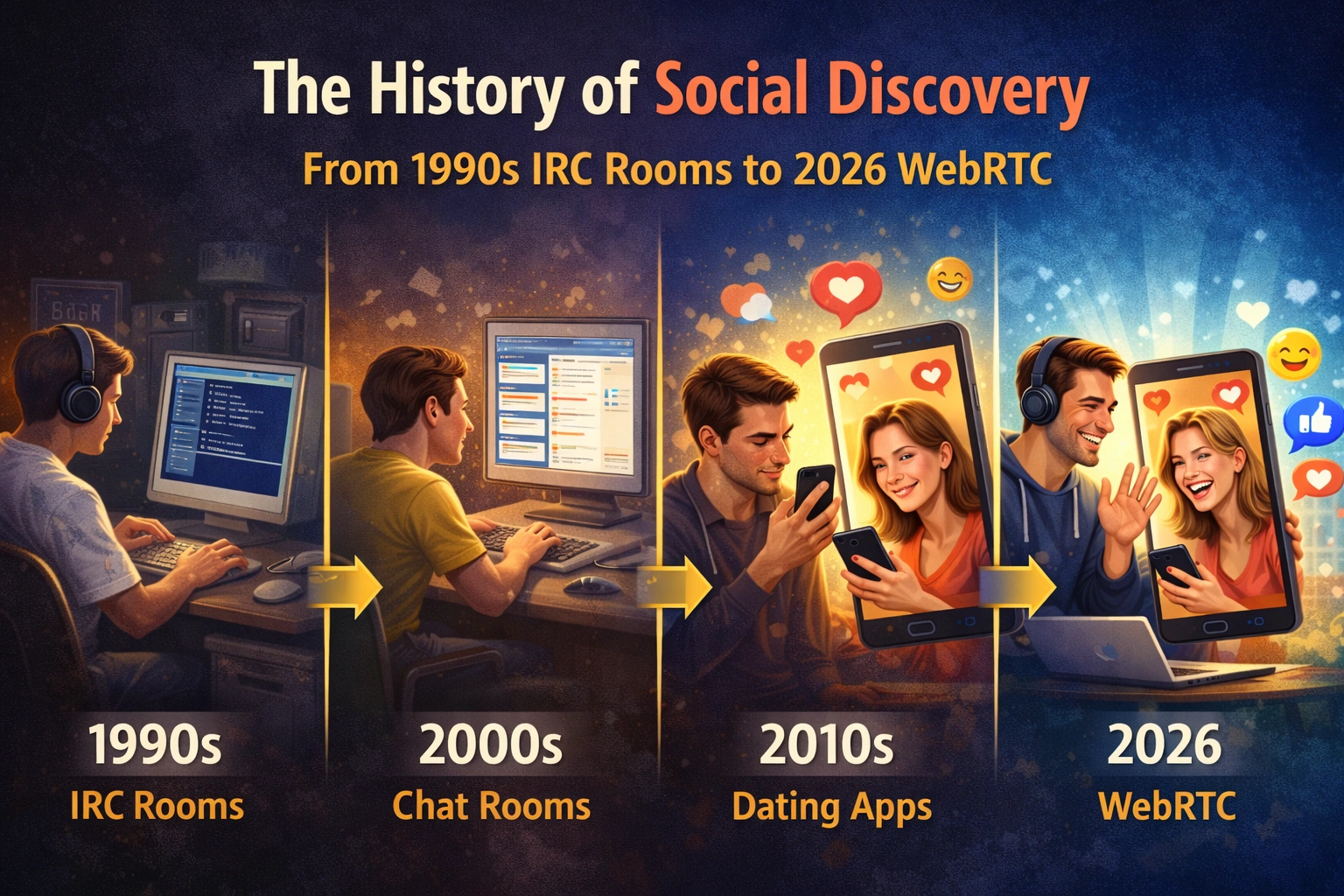
The History of Social Discovery: From 1990s IRC Rooms to 2026 WebRTC
Published by Chatzyo Insights | Educational & Technical History
The human impulse to connect with the unknown is as old as civilization itself, but the *medium* through which we discover strangers has undergone a radical transformation over the last three decades. The internet, at its absolute core, was built to facilitate communication across impossible distances. Yet, the way we experience that communication has shifted from pure, anonymous imagination to hyper-curated surveillance, and now, finally, back to spontaneous authenticity.
To truly understand why millions of users in 2026 are flocking to no-login P2P platforms, we must undergo an educational journey through the history of digital social discovery. The evolution from IRC to WebRTC is not just a story of bandwidth and code; it is the story of human sociology adapting to the digital age.
The 1990s: The Era of Pure Text and IRC
Before the internet had faces, it had words. In the early to mid-1990s, Internet Relay Chat (IRC) and early bulletin board systems (BBS) defined social discovery. You did not have a profile picture, a bio, or a verified identity. You had a handle (a username) and a blinking cursor.
To connect with strangers, you joined specific "channels" (e.g., #philosophy, #india, #music). The beauty of this era was its default anonymity. Because bandwidth was incredibly limited, there was no voice or video. You judged a person entirely by their syntax, humor, and ideas. This was the golden age of the digital Third Place—a neutral ground where socioeconomic status, race, and physical appearance were invisible. The connection was purely cognitive.
The 2000s: The Rise of the Profile and the Death of Anonymity
As dial-up gave way to broadband, the internet changed fundamentally. The launch of platforms like Friendster, MySpace, and ultimately Facebook shifted the paradigm from "discovering strangers" to "cataloging acquaintances."
This era introduced the concept of the Digital Identity. Suddenly, anonymity was viewed with suspicion. Social discovery became anchored to physical reality. You were encouraged to use your real name, upload photos of your real face, and link to your real-world school or workplace. While this connected friends efficiently, it slowly killed the spontaneous magic of the 90s chat room. To meet a stranger online now required you to expose your entire digital dossier to them instantly.
The Late 2000s & 2010s: The Chatroulette Shockwave and the Algorithm
By 2009, people were suffering from early "identity fatigue." They missed the serendipity of the 90s. Enter Chatroulette and early Omegle. These platforms caused a global shockwave by combining the anonymity of IRC with the newly available technology of flash-based webcams. It was chaotic, unregulated, and incredibly popular.
However, because the underlying technology relied on centralized servers and Flash plugins, it was expensive to run and difficult to moderate effectively. As discussed in our analysis of why Omegle ultimately shut down, the lack of secure architecture led to its eventual demise.
Simultaneously, the 2010s saw the rise of algorithmic social media (Instagram, TikTok) and "swipe" mechanics (Tinder). Social discovery was no longer random; it was heavily gated and curated by a corporate algorithm designed to keep you scrolling rather than connecting. The spontaneity was gone, replaced by a hyper-optimized feed.
The 2020s: The WebRTC Revolution and the Return to Spontaneity
To fix the problems of the 2010s, the internet needed a massive technological upgrade. It arrived in the form of WebRTC (Web Real-Time Communication), an open-source project that standardized real-time, high-fidelity audio and video natively within the web browser.
WebRTC changed everything. Suddenly, developers did not need to force users to download a heavy application, install plugins, or route video through expensive centralized servers. WebRTC enabled Peer-to-Peer (P2P) architecture. As we explore in our piece on the future of WebRTC communication, this meant two browsers could connect directly to each other, transferring high-definition video instantly, with near-zero latency.
This technological leap eliminated the friction of social discovery. It allowed modern platforms to resurrect the anonymity and spontaneity of the 1990s IRC rooms, but with the high-fidelity connection of modern video, without the predatory data harvesting of social media apps.
2026 and Beyond: The Post-Algorithm Era
Today, we have entered what sociologists are calling the Post-Algorithm Era. Users are exhausted by curated feeds and curated profiles. They are actively seeking out platforms that enforce a zero-data philosophy.
Modern platforms like Chatzyo represent the synthesis of thirty years of internet history. They take the core sociological appeal of the 1990s chat room—the excitement of speaking to a random stranger, the safety of anonymity, the lack of digital baggage—and power it with the absolute cutting edge of 2026 WebRTC P2P technology.
We have come full circle. By removing the login screens, the algorithmic feeds, and the data brokers, we are returning the internet to its original, most beautiful purpose: a place to simply say "hello" to the world.
Frequently Asked Questions
Internet Relay Chat (IRC) was a text-based protocol created in 1988 that allowed users to join topical channels to talk with strangers anonymously. It laid the sociological groundwork for modern online social discovery, proving that humans have a deep desire to connect outside their immediate physical circles.
The rise of social media networks like MySpace and Facebook shifted the internet's focus and economic models from connecting with anonymous strangers to establishing permanent, real-world digital identities. Connecting online became about managing a public profile rather than spontaneous conversation.
WebRTC (Web Real-Time Communication) allows high-definition, peer-to-peer audio and video to be transmitted directly through a web browser. By removing the need for heavy app downloads, central servers, and account registrations, it has revived the spontaneous, friction-less socializing of the early internet while preserving modern data privacy.