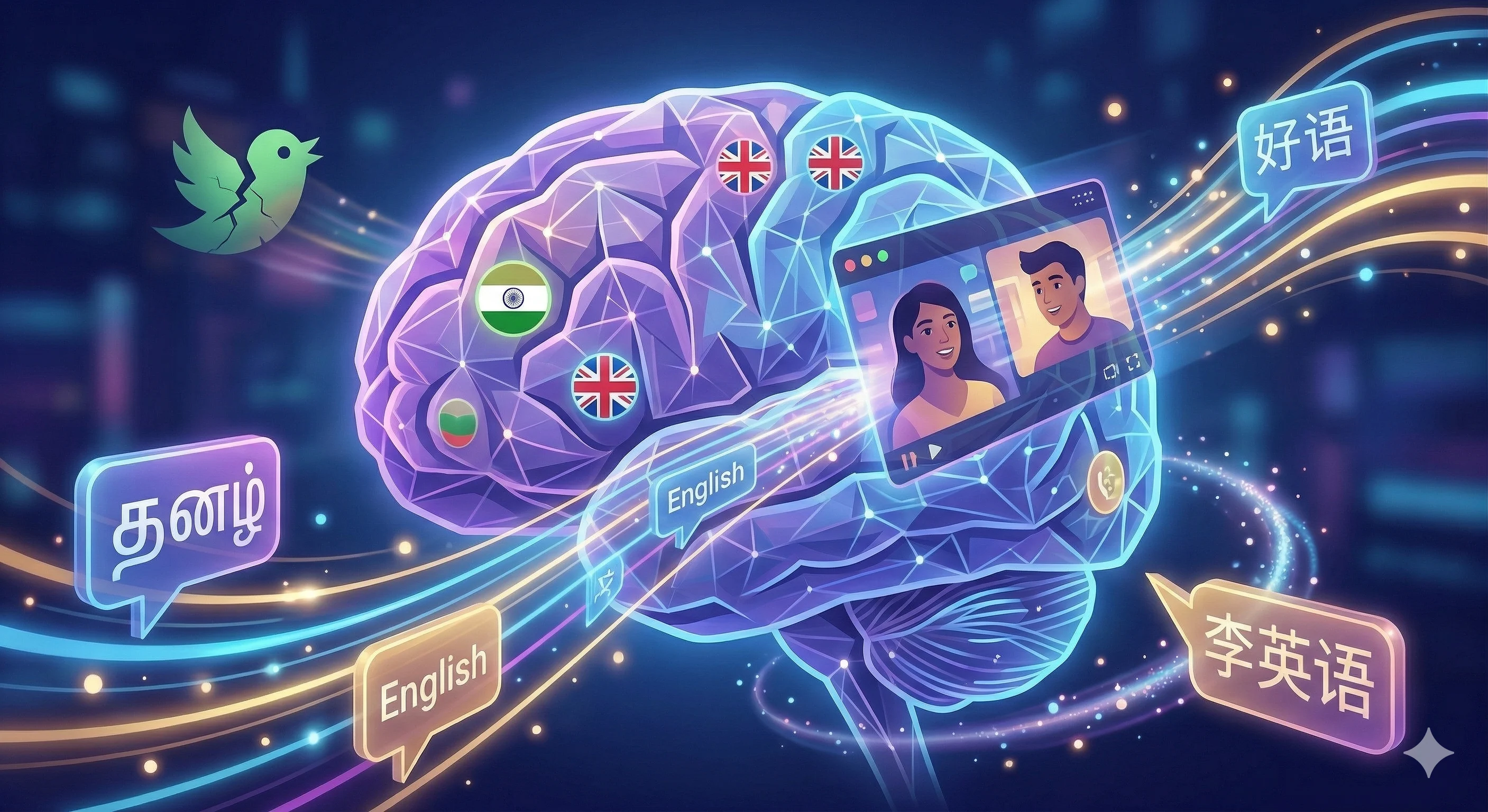
Language Immersion 2.0: Why Real-Time Video is Faster Than Duolingo for Fluency
We are living in the golden age of language learning apps. Millions of people diligently maintain their daily streaks, tapping glowing buttons to translate sentences like "The green owl is eating an apple." Yet, despite months of consistent effort, a startling reality often hits when these learners encounter a native speaker: they freeze. Their minds go blank, and the fluency they felt while playing the app entirely evaporates.
Why does this happen? The answer lies in the neuroscience of language acquisition. Gamified applications are exceptional at teaching vocabulary and basic syntax, but they are woefully inadequate at teaching pragmatics—the ability to use language in real-time, dynamic social contexts. To bridge this gap, modern learners are abandoning the flashcards and turning to random video chat platforms as the ultimate arena for "Language Immersion 2.0."
The Cognitive Load of Spontaneous Conversation
When you use a language learning app, your brain is in a state of low cognitive load. You have all the time in the world to recall a conjugation. There is no social pressure, no background noise, and no requirement to read the other person's body language.
Conversely, a live 1-on-1 video call throws your brain into the deep end of the pool. When you connect with a stranger in a foreign language, two distinct areas of your brain go into overdrive: Broca’s area (which handles speech production) and Wernicke’s area (which handles speech comprehension). Because the conversation is unpredictable, your brain cannot rely on memorized scripts. It is forced to actively synthesize new neural pathways on the fly to survive the social interaction. This intense cognitive pressure is what actually forges permanent fluency.
Overcoming the "Affective Filter"
In the 1980s, linguist Stephen Krashen proposed the "Affective Filter Hypothesis." He argued that negative emotions—such as anxiety, fear of embarrassment, and self-doubt—create a mental block that prevents the brain from acquiring language. This is why traditional classrooms, where students are afraid of being mocked by peers for a bad accent, often fail to produce fluent speakers.
This is where the magic of the "Next" button comes into play. On a platform like Chatzyo, you are engaging in an anonymous digital space. You do not know the person on the screen, and you will likely never see them again. If you butcher a sentence, use the wrong tense, or completely misunderstand a joke, there are zero real-world consequences.
This anonymity drastically lowers the Affective Filter. It gives learners the psychological safety to make the hundreds of embarrassing mistakes that are fundamentally necessary to master a new language.
The 70/38/55 Rule and Non-Verbal Context
Albert Mehrabian's famous rule states that communication is 7% spoken words, 38% tone of voice, and 55% body language. When you learn a language purely through text or audio exercises, you are missing 55% of the data.
By engaging in video-based interactions, you gain access to vital context clues. If a native speaker uses a colloquialism you don't know, you can often deduce its meaning just by observing their facial expressions or hand gestures. Furthermore, seeing the physical movement of a native speaker's lips and tongue helps your brain instinctively mirror those movements, rapidly improving your own pronunciation and accent—a phenomenon rooted deeply in mirroring theory.
Actionable Strategies for Video Chat Immersion
If you want to use random chat to accelerate your language learning, do not just log on and hope for the best. Treat it like a digital language lab. Here is a proven strategy for Language Immersion 2.0:
1. Target Regional Rooms
Don't leave your immersion entirely up to chance. Use localized server options. If you are learning English, spending an hour in UK chat rooms will expose you to British slang, pacing, and accents, while USA chat will give you the North American equivalent. If you are learning a regional language like Tamil, jumping into dedicated regional chat servers provides an immediate, highly concentrated dose of native speakers.
2. Prepare a "Survival Script"
Before you turn on your webcam, write down three sentences in your target language and stick them next to your camera lens:
- "Hello, I am learning this language. Can we practice?"
- "Could you please speak a little slower?"
- "How do you say [Word] in your language?"
Having these survival phrases ready reduces initial panic and clearly sets the context for the stranger. Most people are incredibly flattered when someone is trying to learn their native tongue and will eagerly become temporary teachers.
3. Embrace the "Skip"
Not everyone you meet will have the patience to talk to a beginner. That is perfectly fine. The beauty of the platform is the velocity of connection. If someone skips you because of a language barrier, don't take it personally. Just click "Next." Within a few minutes, you will find an empathetic stranger who is willing to chat, correct your grammar, and help you grow.
Frequently Asked Questions About Chat Immersion
If you know how to say "Hello," "How are you," and "I don't understand," you are ready. The fastest way to learn vocabulary is to desperately need a word in the middle of a live conversation. That urgency makes the memory stick forever.
This is actually the ideal scenario! It is called "Total Immersion." You will be forced to use hand gestures, facial expressions, and the few words you do know to bridge the gap. It is exhausting, but it is the fastest route to fluency.
Because live conversation is mentally taxing, keep it short at first. Aim for 15 to 20 minutes of active video chatting in your target language daily. This is vastly more effective than two hours of passive app swiping.
Conclusion: The Ultimate Language Test
Language is not a puzzle to be solved on a glowing smartphone screen; it is a tool meant to connect human beings. While apps are fantastic for building your foundational vocabulary, they are just the training wheels. To truly ride the bicycle of a new language, you have to take it out into the chaotic, unpredictable, and beautiful traffic of real human conversation. Turn on your camera, accept the awkwardness, and let the world be your classroom.