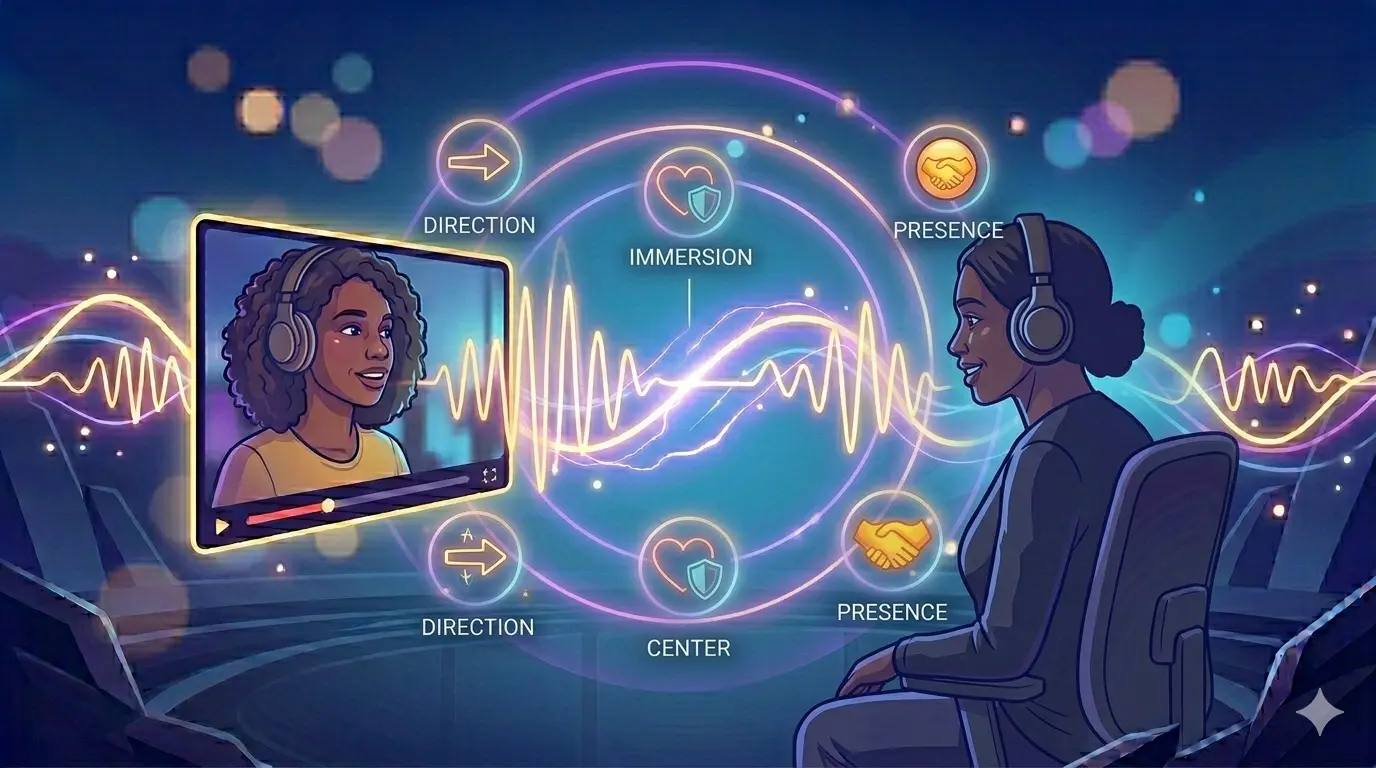
Spatial Audio in Video Discovery: Why the Direction of a Stranger's Voice Matters
Over the last decade, the technology driving random video chat has experienced a massive visual revolution. We have transitioned from grainy, pixelated webcams that looked like stop-motion animation to high-definition, 60-frames-per-second feeds. Yet, while our eyes have been treated to a feast of upgrades, our ears have largely been left behind. For years, digital audio has remained profoundly "flat."
But as we navigate the digital landscape of 2026, a silent revolution is fundamentally changing how we experience online socialization. The next frontier isn't just about clearer video; it is about **Spatial Audio**. It is the transition from hearing a stranger's voice trapped "inside your head" to hearing their voice exist in a physical, three-dimensional space around you. And this shift is radically altering the psychology of digital human connection.
The Problem with "Flat" Digital Sound
To understand why spatial audio is a game-changer, we must first understand the limitations of standard digital communication. When you hop into a traditional 1-on-1 video call on legacy platforms, the audio is typically delivered in mono, or basic stereo. The sound is pumped equally into your left and right ear canals.
From a biological perspective, this is highly unnatural. In the physical world, sound is never flat. If you are sitting in a coffee shop in Coimbatore and someone speaks to you from across a table, the sound waves hit your left ear a fraction of a millisecond before they hit your right ear. The sound waves also bounce off your shoulders and the unique shape of your outer ear (the pinna). Your brain subconsciously calculates these micro-delays and frequency shifts to pinpoint exactly where the person is sitting in relation to your body.
When this directional data is stripped away by flat digital audio, the brain goes into overdrive. It has to constantly work to parse the voice, leading to a phenomenon known as "Zoom Fatigue." Over long periods, listening to a disembodied voice that seems to originate from the center of your skull is physically and neurologically exhausting.
Psychoacoustics: The Biology of Trust
Why does the direction of a voice matter so much in identifying high-value connections? It comes down to evolutionary biology and psychoacoustics.
Our auditory system evolved primarily as a threat-detection and social-bonding mechanism. When you hear a voice in 3D space, your brain feels "safe." It understands the physical geometry of the environment. In contrast, flat audio triggers a mild, subconscious stress response because the sound source is biologically impossible to locate.
How WebRTC Delivers 3D Sound in the Browser
In the past, achieving spatial audio required downloading massive, heavy software applications designed for high-end PC gaming or virtual reality. However, the modern web has evolved. As we discussed in our article on WebRTC vs. WebSockets, modern browser protocols are now capable of rendering complex data streams directly in the client.
Through advanced Web Audio APIs integrated with WebRTC, platforms like Chatzyo can now process **Head-Related Transfer Functions (HRTFs)** in real-time. Even without a VR headset, using just a standard pair of stereo headphones, the browser can simulate the micro-delays and frequency shifts of physical space.
When you connect with someone in a USA chat room, the audio isn't just loud or quiet; it has "width." If they lean slightly to the left of their camera, their voice will subtly shift to the left side of your headphones. It creates the visceral illusion that you are sitting across a real, physical table from them.
Spatial Audio and the "Ghost Architecture"
One of the most fascinating aspects of spatial audio is how perfectly it aligns with privacy-first philosophies. Creating a 3D audio landscape does not require the platform to collect any extra personal data from you. It happens purely through real-time, client-side math.
This adheres perfectly to Chatzyo's Ghost Architecture. We can provide a highly immersive, deeply intimate acoustic environment for two strangers to connect, without ever needing to store an ounce of profile data or tracking information. The immersion is ephemeral; the moment you click "Next," the 3D space vanishes entirely, leaving no trace behind.
The Future of Platonic Social Discovery
As we push further into the late 2020s, the goal of random video platforms is no longer just to "connect" two IP addresses. The goal is to facilitate genuine empathy. Empathy requires presence, and presence requires sensory accuracy.
When you can hear the exact direction of a stranger's laugh, when the subtle sighs or the scratching of a pen on their desk occur in a designated spatial plane around your head, the screen disappears. You stop feeling like you are staring at software, and you start feeling like you are sharing a room. Spatial audio is not a gimmick; it is the final necessary bridge to make digital social discovery feel indistinguishable from real-world human connection.
Frequently Asked Questions
No! That is the beauty of HRTF technology in modern browsers. While high-end studio headphones provide a wider soundstage, any standard pair of stereo earbuds or headphones is capable of conveying the left/right micro-delays needed to trick your brain into hearing 3D space.
WebRTC is highly optimized for modern hardware. While processing spatial audio does require slightly more CPU power than standard flat audio, it is negligible compared to the battery drain of rendering video. For more tips on efficiency, check our guide on P2P battery saving secrets.
Conclusion: Hearing the World Differently
The visual web connected our eyes, but the spatial web is connecting our environments. By embracing the psychoacoustics of directional sound, we are curing digital fatigue and building a deeper layer of trust into anonymous interactions. The next time you put on your headphones and start a conversation, pay attention not just to what the stranger is saying, but *where* they are saying it from. You might just find that the connection feels more real than ever before.