The "Zero-Latency" Dream: How Peer-to-Peer Connections Handle Poor 4G/5G Signals
In the landscape of modern digital communication, few things are as frustrating as video lag. The frozen face, the robotic voice, the awkward overlapping sentences—these technical hiccups destroy the natural flow of human conversation. As we explored in our piece on first impressions and micro-expressions, the human brain requires instantaneous visual feedback (measured in milliseconds) to register empathy and trust.
While 2026 has brought widespread 5G infrastructure, the reality is that over 80% of users on random video chat platforms are connecting via mobile devices. This means they are often moving, passing through dead zones, or sitting at the edge of Wi-Fi networks. How do modern browser-based platforms maintain a seamless "zero-latency" illusion when the underlying internet connection is inherently unstable? The answer lies in the engineering magic of Peer-to-Peer (P2P) WebRTC architecture.
The TCP vs. UDP Battle: Intentionally Dropping Packets
To understand why WebRTC excels on mobile connections, you have to understand how data travels. Most of the internet (like loading a webpage or sending an email) relies on a protocol called TCP (Transmission Control Protocol). TCP is a perfectionist. It ensures every single packet of data arrives perfectly in order. If a packet is lost due to a bad 4G signal, TCP stops everything, goes back, and asks the server to resend the missing piece. This guarantees accuracy, but it creates massive delays—otherwise known as "buffering."
Real-time video cannot afford to wait. In a 1-on-1 video call, if a frame of video from 3 seconds ago gets lost, you don't want it arriving 5 seconds later; the moment has passed. WebRTC utilizes UDP (User Datagram Protocol). UDP is fast and ruthless. It fires packets of data continuously and does not care if a few get lost along the way. By intentionally ignoring lost packets, the video feed continues to play in real-time, completely eliminating the buffer wheel.
Removing the Middleman: True Peer-to-Peer Routing
As discussed in our comparison of browser video vs. heavy native apps, many legacy platforms route your video through a centralized data center. If a user in a regional chat room in India tries to talk to someone in the same city, legacy apps might route the video feed to a server in Singapore and back. This is highly inefficient.
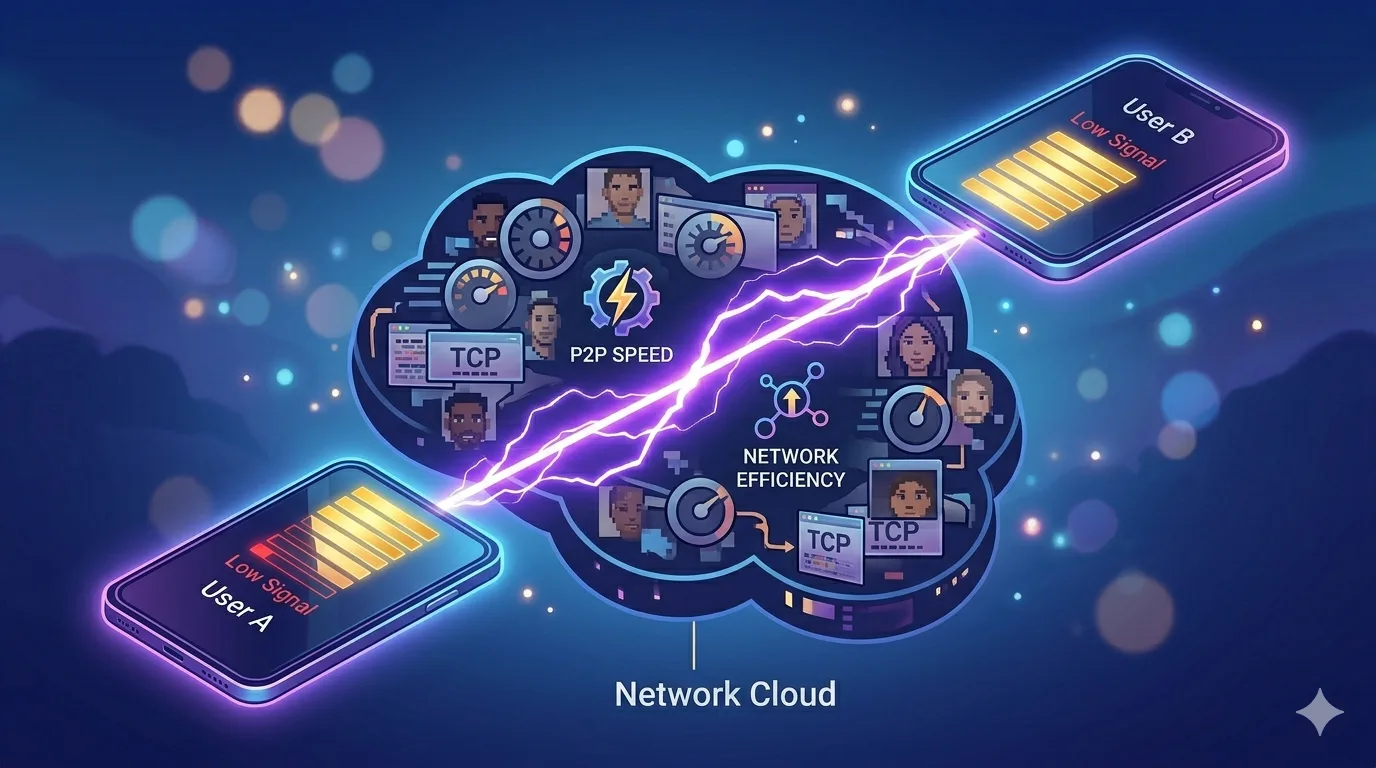
WebRTC is designed to be purely Peer-to-Peer (P2P). Your browser establishes a direct, encrypted pipeline to the stranger's browser. The data travels the shortest possible physical distance over the internet backbone. This is why connecting with someone locally feels incredibly sharp, and even global connections to USA chat users maintain strict synchronization.
NAT Traversal: The Magic of STUN and TURN Servers
There is a catch to P2P. Modern routers and mobile carriers use Firewalls and NATs (Network Address Translation) for security. A NAT hides your device's actual IP address from the outside world. If two devices are hidden, how can they connect directly?
WebRTC solves this using a process called ICE (Interactive Connectivity Establishment), leveraging two types of helper servers:
- STUN Servers: Think of a STUN server as a mirror. Your phone pings the STUN server to ask, "What does my public IP address look like from the outside?" Once your phone knows its public face, it trades this information with the peer, allowing a direct connection to punch through the firewall.
- TURN Servers: Occasionally, a mobile carrier's firewall is so strict (Symmetric NAT) that a direct P2P connection is impossible. In this fallback scenario, the traffic is temporarily relayed through a highly optimized TURN server to keep the conversation alive. We prioritize secure architecture, so even when relayed, the media remains end-to-end encrypted.
Adaptive Bitrate and Graceful Degradation
What happens when you walk out of a strong 5G area into a weak 4G zone while chatting? WebRTC uses "Adaptive Bitrate Streaming." The system monitors the available bandwidth in real-time multiple times per second.
If your signal drops, the WebRTC engine instantly compresses the video feed, dropping the resolution from 720p down to 360p or lower. It operates on a principle of "Graceful Degradation"—sacrificing visual sharpness to protect the audio. In human conversation, a slightly blurry face is acceptable, but choppy, broken audio ruins comprehension. By prioritizing the audio packets, the connection survives the dead zone seamlessly until you step back into a strong signal.
Frequently Asked Questions About Mobile Video Chat
Actually, P2P often uses less overhead than centralized apps because it bypasses unnecessary server routing. However, high-quality video will inherently use data. The adaptive bitrate automatically lowers data consumption if you are on a limited mobile plan.
That is WebRTC doing its job! When your mobile signal fluctuates, the system drops the video quality (blurriness) to prevent the call from disconnecting entirely or buffering. Once the signal stabilizes, the sharp quality returns.
While P2P does involve IP address exchange for routing, modern browsers obscure exact geolocation data. We implement strict WebRTC security protocols to ensure your IP cannot be easily scraped to identify your exact physical address, maintaining platform safety.
Conclusion: Engineering the Human Connection
The "Zero-Latency" dream is not achieved by building heavier apps; it is achieved by building smarter, leaner pipelines. By harnessing the power of UDP protocols, intelligent NAT traversal, and dynamic bitrates, WebRTC transforms fluctuating, chaotic 4G and 5G signals into stable, real-time human interactions. The next time you experience a perfectly synchronized laugh with a stranger halfway across the world, you can thank the invisible, lightning-fast P2P architecture working beneath the surface of your browser.