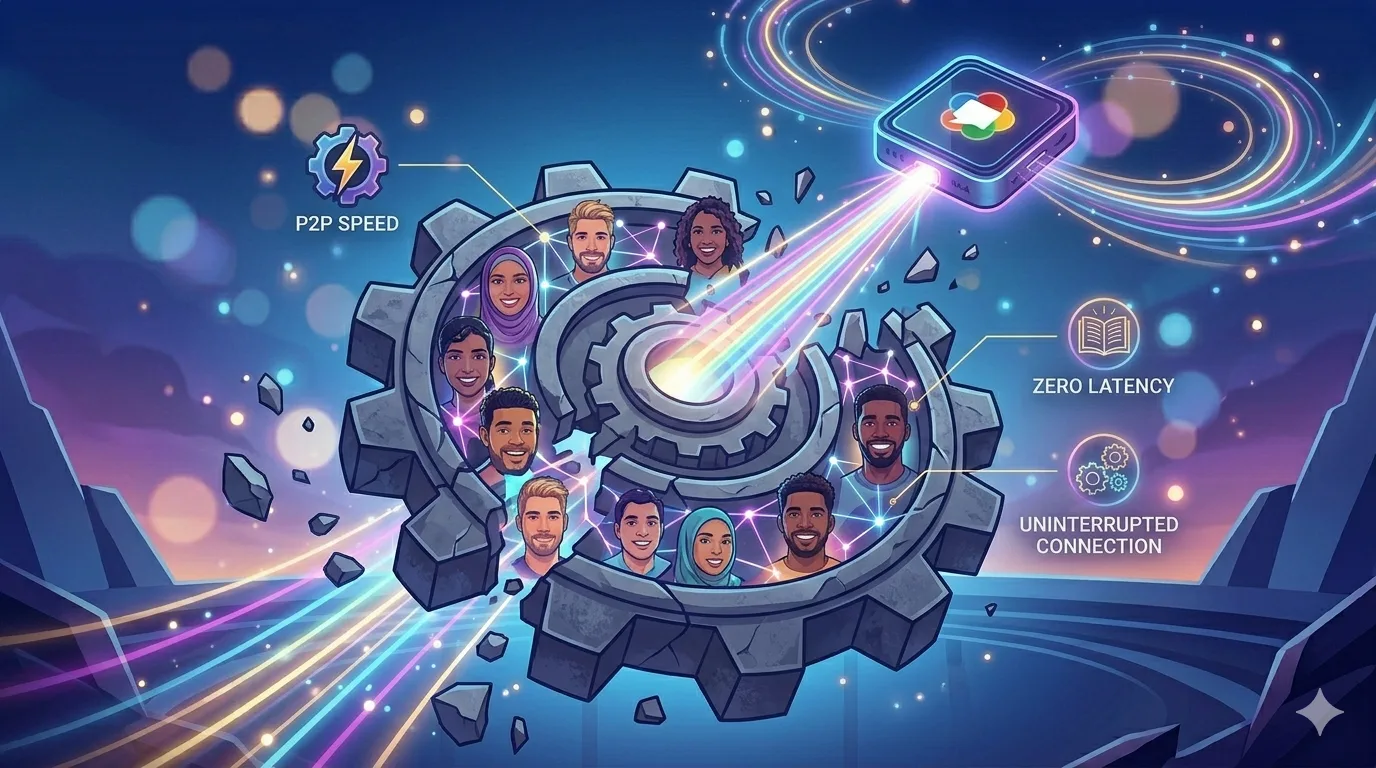
The Death of the Buffer Wheel: How 2026 Tech is Eliminating Connection Lag
For an entire generation of internet users, the spinning buffer wheel was a universal symbol of frustration. It was the great interrupter of movies, the killer of punchlines, and the bane of digital communication. We accepted it as a necessary evil of the information age. But as we navigate the digital landscape of 2026, the buffer wheel is rapidly going extinct.
Nowhere is this technological evolution more critical than in random video chat environments. When you connect with a stranger, every millisecond counts. In this article, we will break down the precise engineering breakthroughs—from AI-driven codecs to edge signaling—that have allowed platforms to finally hammer the final nail into the buffer wheel's coffin, ensuring that your real-time conversations are genuinely real-time.
The Legacy Architecture: Why We Buffered in the 2010s
To appreciate the speed of 2026, we have to look back at the architectural bottlenecks of the past. Ten years ago, video communication was heavily reliant on centralized infrastructure. If a user in a regional chat room wanted to video call their neighbor across the street, the application would often route the massive video file up to a central cloud server (sometimes in a different country), encode it, process it, and send it back down to the neighbor.
This round-trip journey took time. Moreover, legacy systems relied heavily on TCP protocols, which required strict packet ordering. If a single packet of video data was delayed or lost, the entire video player would freeze and display the buffer wheel while it desperately waited for the missing data to arrive. As we covered in our WebRTC vs. WebSockets breakdown, this insistence on perfection was the primary cause of connection lag.
AV1 and AI-Powered Codecs: Squeezing the Data
The first major leap in killing the buffer wheel came not from changing the internet pipes, but from changing the size of the water flowing through them. Video data is notoriously heavy. Transmitting uncompressed 1080p video requires massive bandwidth.
By 2026, the industry has universally adopted advanced, royalty-free codecs like AV1, largely replacing older standards like H.264. AV1 is incredibly efficient, able to compress high-definition video into file sizes nearly 30-40% smaller than its predecessors. But the real magic happens when AI is injected into the encoding process.
Modern browser engines now utilize lightweight neural networks to analyze the video feed in real-time. The AI recognizes which parts of the frame are static (like the wall behind you) and which are dynamic (like your moving lips). It compresses the static background aggressively while allocating bandwidth specifically to your facial expressions. Because the overall data package is dramatically smaller, it can slip through even the most congested networks without ever triggering a buffer.
Edge Computing and Decentralized Signaling
While the actual media in a 1-on-1 video call is routed Peer-to-Peer, the initial handshake—finding a partner, negotiating IP addresses, and opening the connection—requires a signaling server. If the signaling server is located far away, establishing the initial connection can take several seconds (the "finding a partner" loading screen).
The death of this delay comes courtesy of Edge Computing. Instead of housing signaling servers in a few massive data centers, modern architectures distribute lightweight signaling nodes at the "edge" of the network, as close to the user's geographic location as possible. When a user logs onto USA chat in Chicago, their connection handshake is handled by a node physically located in the Midwest, rather than routing to a server in California. This reduces the initial connection time from 3 seconds down to 200 milliseconds. It is virtually instantaneous.
WebRTC's Aggressive Pacing Mechanisms
Finally, we must credit the evolution of the WebRTC protocol itself. Modern WebRTC implementations have mastered the art of network prediction. Instead of waiting for a network to fail and then displaying a buffer wheel, WebRTC proactively monitors round-trip times and packet loss ratios constantly.
This is crucial for mobile 5G and 4G connections, which are prone to sudden spikes in interference. WebRTC uses pacing mechanisms that dynamically throttle the bitrate before the network gets congested. It gracefully lowers the resolution or frame rate to ensure the data never stacks up in a queue. In the engineering world, it is widely accepted that dropping the visual quality by 10% is infinitely preferable to freezing the video entirely.
The Psychology of Instant Connectivity
Why does eliminating the buffer wheel matter so much? Because in the context of random video discovery, patience is nonexistent. The user interface of modern platforms is built around the "Next" button.
If a connection takes more than 1.5 seconds to establish, the user's brain perceives friction. They might assume the platform is broken or that there is no one online, prompting them to leave in search of faster, less heavy alternatives. By achieving true zero-latency connections, we maintain the user's state of "flow." They can jump from a conversation in London to a conversation in Tokyo seamlessly, making the digital world feel as immediate and responsive as turning around to speak to someone in the same room.
Frequently Asked Questions About Connection Lag
While the technology is designed to eliminate buffering, a complete network failure (e.g., your router loses internet connection entirely) will still cause a freeze. WebRTC can adapt to slow speeds, but it cannot invent internet where none exists!
Not necessarily. Thanks to AV1 and AI codecs, you are getting higher visual quality with less data. However, if your specific network is struggling, the system will intentionally lower your resolution to prioritize a smooth, non-buffering experience.
Yes. WebRTC mandates that all media streams are end-to-end encrypted (DTLS-SRTP). Edge computing only speeds up the routing and handshakes; it does not decrypt or store your video data.
Conclusion: The Silent Infrastructure
The greatest compliment you can pay to a piece of technology is to forget it is even there. For years, the buffer wheel was a loud, obnoxious reminder of the internet's limitations. Today, the complex symphony of edge nodes, AI encoding, and pure UDP transmission happens entirely silently, in the background. We have finally reached an era where the technology disappears, leaving nothing between you and the person on the other side of the screen but genuine human connection.