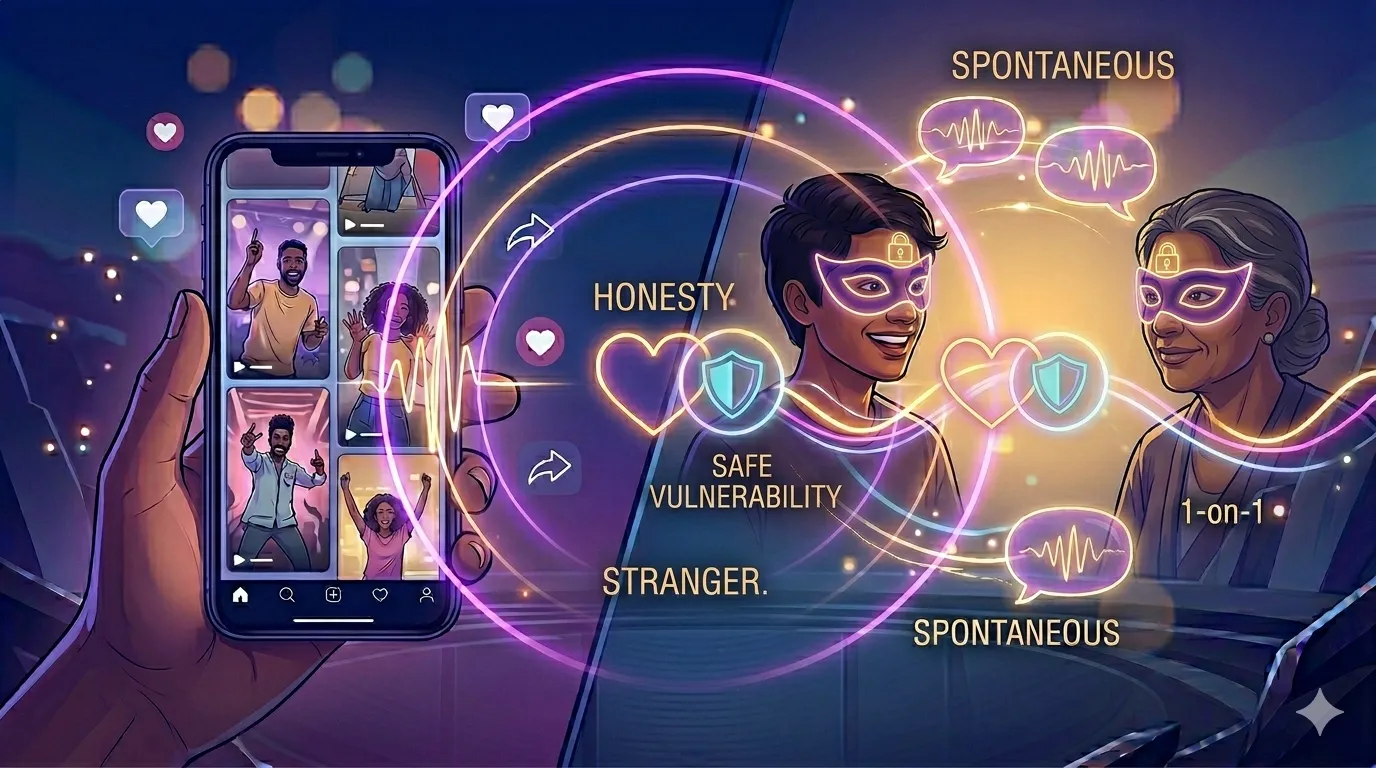
The Paradox of Anonymity: Why We Are More Honest with Strangers Than Friends
Human psychology is filled with ironies. We spend years building relationships with friends and family, establishing trust, and nurturing bonds of intimacy. Yet, when faced with our most profound secrets, darkest fears, or most controversial thoughts, we often find ourselves silent. We curate our words, edit our truths, and present a polished version of ourselves to those we love most. Paradoxically, many people find it infinitely easier to be radically honest with an absolute stranger they have known for less than five minutes on a 1-on-1 random video chat platform.
This phenomenon, known as the "Paradox of Anonymity," reveals a fundamental truth about the nature of human connection and social risk. In this extensive educational dive, we explore the sociological and neurological reasons why a no-login revolution is providing a necessary sanctuary for authentic human expression in an increasingly curated digital world.
1. The Theory of Social Risk and Relationship Maintenance
The primary reason for our lack of honesty with friends is the existence of Social Risk. Every relationship we have is an investment. When we reveal a hidden part of ourselves to a friend, we are introducing a variable that could potentially disrupt the stability of that relationship. We fear judgment, we fear the loss of status, and most importantly, we fear that the information will be used against us in the future.
Within a social circle, information is semi-permanent. A secret told today can be weaponized during a conflict five years from now. This "cost of honesty" creates a psychological barrier that prevents total vulnerability. We edit our truths to protect the longevity of the bond.
2. The "Stranger-on-a-Train" Phenomenon
Psychologists have long studied the "Stranger-on-a-Train" effect. This occurs when an individual discloses deeply personal information to someone they know they will likely never see again. Because the interaction is ephemeral, the traditional consequences of honesty are suspended. There is a profound psychological relief in being "seen" without being "known."
Modern platforms utilizing WebRTC technology have digitized this effect. When two peers connect directly through a browser, they enter a space of immediate, temporary intimacy. As we discussed in our guide on reclaiming digital Third Places, these anonymous interactions provide a safe haven where the stakes are zero, but the emotional reward is high.
3. Comparative Analysis: Friends vs. Strangers
To understand the depth of this paradox, let's compare the dynamics of disclosure in these two distinct environments.
| Feature | Close Friends | Anonymous Strangers |
|---|---|---|
| Consequence | High (Potential Relationship Rupture) | Zero (Interaction Ends Instantly) |
| Curation | High (Maintenance of Identity) | Low (Radical Authenticity) |
| Reputation | At Risk | Non-Existent |
| Duration | Long-Term / Persistent | Ephemeral / Temporary |
4. Digital Identity and the Performance Burden
Traditional social media platforms have forced us into a state of permanent performance. We don't just exist online; we manage a brand. This curation leads to significant social media burnout. With friends watching, we cannot admit failure, sadness, or controversial thoughts without damaging the digital avatar we have spent years constructing.
This is where a zero-data philosophy changes the game. By ensuring that no session data, no logs, and no profiles are maintained, platforms like Chatzyo allow the user to momentarily step out of their "character." You are honest not because you are hidden, but because your past is not following you.
5. The Neurological Relief of Total Disclosure
There is a physiological benefit to being honest. Keeping secrets or suppressing truths requires significant cognitive effort, which can lead to increased cortisol levels and stress. When we disclose a truth to a stranger in a random video chat, our brain experiences a "release" similar to a physical burden being lifted. This release of tension provides a sense of clarity and well-being that is often difficult to achieve in the high-stakes environment of our real-world social circles.
6. Honesty as a Psychological Dress Rehearsal
Sharing an honest thought with a stranger can act as a "dress rehearsal" for real-life conversations. By articulating a feeling or opinion to a neutral party in a 1-on-1 India chat, we can refine our thoughts and gauge our own emotional reaction before bringing the topic to our friends or family. In this sense, anonymity isn't an escape from reality; it's a practice ground for a more honest version of it.
7. Safety, Privacy, and Authentic Discovery
While anonymity invites honesty, it also requires a robust framework for safety. Understanding how to talk to strangers safely is the necessary prerequisite for benefiting from this paradox. When safety is ensured through technical protocols, the "Shadow" self is allowed to speak, leading to profound moments of discovery that are simply impossible on curated, identity-locked platforms.
Frequently Asked Questions
It is easier because there are no long-term consequences. A stranger does not belong to your social circle, cannot use your secrets against you later, and holds no pre-existing judgments about you. This lack of social risk creates a unique safe space for total honesty.
By removing the requirement for a persistent identity (email or username), the 'no-login' model ensures that the conversation is ephemeral. Once the browser is closed, the session data vanishes, encouraging deeper vulnerability without fear of a permanent record.
Yes. Expressing hidden truths or complex feelings to a neutral stranger can act as a psychological dress rehearsal. It allows individuals to process emotions and gain confidence before addressing similar topics with friends or family in the real world.