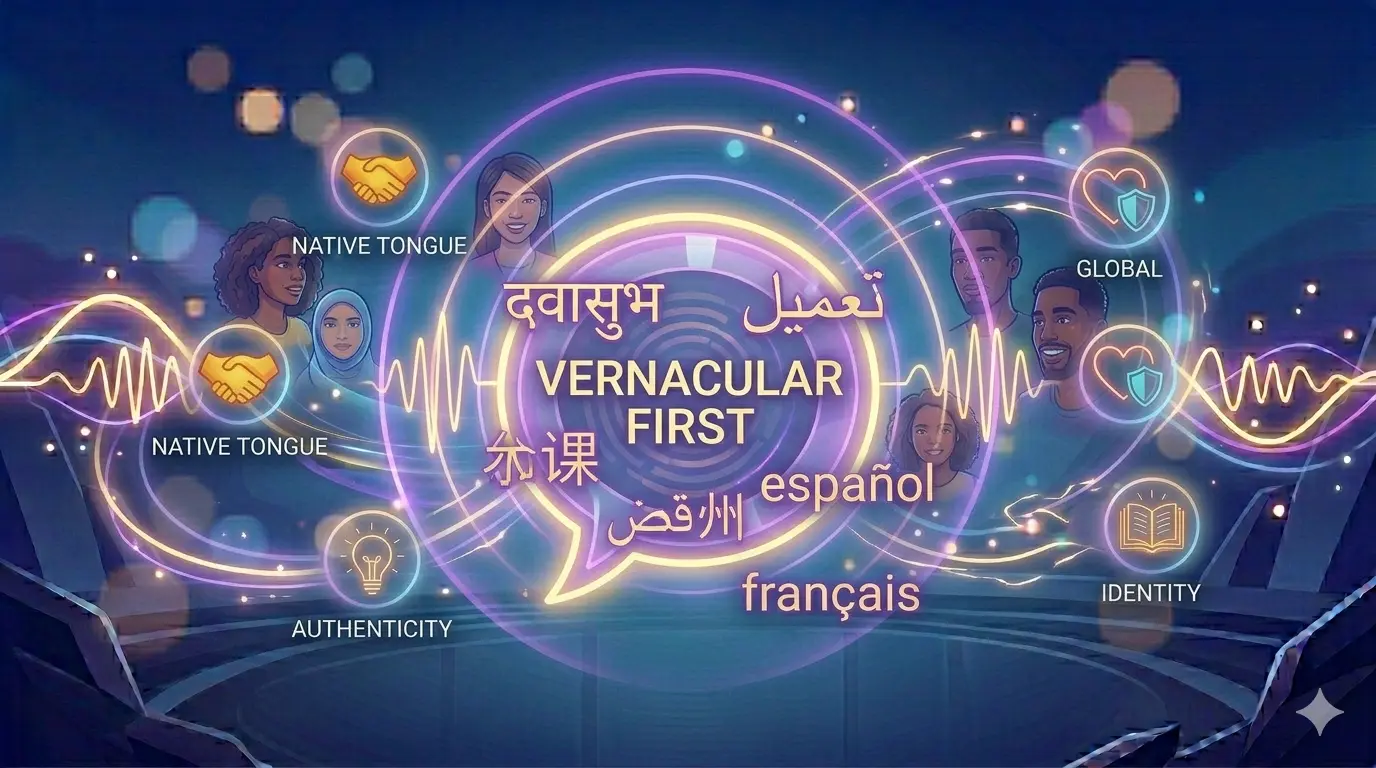
The Rise of "Vernacular First" Discovery: Why Speaking Your Native Tongue is Trending
In the early decades of the internet, there was a prevailing assumption that digital globalization meant linguistic homogenization. The implicit rule of the World Wide Web was that to participate in the global village, you had to speak the global language: English. Keyboards were designed for it, early algorithms favored it, and international social networks defaulted to it.
However, as we move through 2026, the sociology of the internet is experiencing a massive course correction. The era of the "English-default" internet is making way for a new, powerful movement: **Vernacular First Discovery**. Users are realizing that while global communication is useful for business, it is often inadequate for authentic human connection. In the realm of random video chat, the ability to speak, joke, and empathize in your mother tongue is becoming the ultimate luxury.
The Cognitive Load of the Second Language
To understand why vernacular socializing is booming, we must look at cognitive psychology. Speaking a second language—even if you are highly fluent—requires a baseline of active processing power. Your brain is constantly translating, searching for vocabulary, and parsing foreign idioms in real-time.
When you connect with a stranger on a digital platform, the first few seconds are critical. You are already utilizing significant cognitive energy to read their body language, assess their environment, and formulate a greeting. If you add the friction of a second language to this process, the interaction often becomes stilted and formal. The Active Listener framework, which relies on rapid micro-affirmations and emotional echoing, is incredibly difficult to execute when you are mentally translating every sentence.
Conversely, speaking in your native tongue drops this cognitive load to zero. You bypass the translation layer and communicate directly from your emotional core. The conversation flows faster, the pauses are shorter, and the connection deepens exponentially.
Humor, Slang, and Emotional Nuance
Authenticity lives in the nuances that cannot be translated. Humor, in particular, is deeply tied to the cultural shorthand and slang of a specific region. A perfectly timed joke in Tamil might rely on a specific intonation or a reference to local pop culture that completely loses its punch when translated into English.
Furthermore, empathy is a vernacular experience. When someone is expressing joy, frustration, or vulnerability, the exact words they use in their mother tongue carry historical and emotional weight. A platform that forces users to express complex emotions in a non-native language creates an inherent barrier to intimacy. By prioritizing vernacular connections, we allow people to bring their entire, unfiltered cultural identity to the screen.
The Boom of Regional Rooms: A Case Study
The "Vernacular First" trend is not just a theory; it is clearly visible in the data architecture of modern platforms. As internet infrastructure (like 5G and fiber optics) expands deeply into Tier 2 and Tier 3 cities globally, millions of users are coming online who are "vernacular natives." They are not looking for a watered-down global experience; they want a hyper-local digital hangout.
Take India as a prime example. The tech ecosystem in cities like Coimbatore and Chennai has exploded, bringing a massive influx of users who proudly prioritize their linguistic heritage. This has led to the skyrocketing popularity of dedicated regional spaces, such as our heavily trafficked Tamil Chat rooms. In these spaces, users can connect with people who not only speak their language but understand their hyper-local context—from festival preparations to local political debates.
This doesn't mean international exploration is dead. A user might spend their Friday night in a UK Chat room practicing English and exploring foreign cultures, and then spend their Saturday in a vernacular room seeking the deep comfort of home. Both experiences are valid, but the vernacular experience is what turns casual users into dedicated community members.
Local Chaos in the Post-Algorithm Era
The rise of native-tongue chatting is intimately tied to what we call the Post-Algorithm Era. Users are fatigued by curated, predictable feeds. They want the serendipity and "chaos" of random connection.
Interestingly, chaos doesn't have to mean connecting with someone 10,000 miles away. Connecting with a random stranger who lives in your own state, who speaks your exact dialect, but whom you have never met, provides a uniquely thrilling form of serendipity. It reminds you that your own backyard is full of fascinating, unpredictable human beings.
Infrastructure for the Vernacular Web
How do you build a platform that supports this hyper-local discovery without violating user privacy? The answer lies in zero-data architecture.
Legacy social networks build vernacular communities by invasively tracking a user's location, their browser language settings, and their friend networks. At Chatzyo, we rely entirely on our Ghost Architecture. We don't need to know where you live to connect you with your culture. We simply offer the rooms, and you self-select where you want to be. The routing is based purely on your immediate choice, not your permanent demographic profile.
Frequently Asked Questions
Real-time AI translation is advancing rapidly, but translation only solves the *informational* barrier. It does not solve the *emotional* barrier. An AI voice translating a joke will never replace the warmth and cadence of a human speaking their mother tongue. Vernacular connection is about emotional resonance, not just data transfer.
Yes. Regardless of the language spoken, our core WebRTC security protocols and Community Guidelines remain in full effect across all rooms. Anonymity is preserved, and the "Next" button is always your strongest tool for curating your environment.
Conclusion: The Future is Hyper-Local
The internet of 2026 is vast, but its users are realizing that bigger isn't always better. While the ability to speak to anyone in the world is a technological marvel, the ability to be deeply understood by someone is a human necessity. The "Vernacular First" movement proves that as our technology reaches further across the globe, our desire to connect with our roots, our culture, and our native tongue only grows stronger.