Battery Drain Secrets: Why P2P Chat Uses Less Juice Than Traditional Social Media
We've all been there: you leave the house with your smartphone at 100%, and by mid-afternoon, the dreaded red battery icon appears. You haven't even watched a full movie or played an intensive 3D game; you've simply been scrolling through your favorite social media feeds. This phenomenon is known as "Passive Battery Drain," and it is one of the most persistent engineering challenges of the smartphone era.
At first glance, it seems counterintuitive that a random video chat platform streaming live, two-way audio and video could possibly consume less battery life than a text and image-based social media application. Video is heavy, right? While video data is indeed large, the way the data is processed is what determines battery life. Today, we are opening the hood on lithium-ion consumption to explain why browser-based Peer-to-Peer (P2P) architecture is secretly the most energy-efficient way to socialize.
The Hidden Tax of the "Always-On" Native App
To understand battery drain, we must first look at what traditional social media apps are doing when you are not actively using them. As we explored in our deep-dive on browser vs. heavy native apps, modern native applications are designed to be "Always-On."
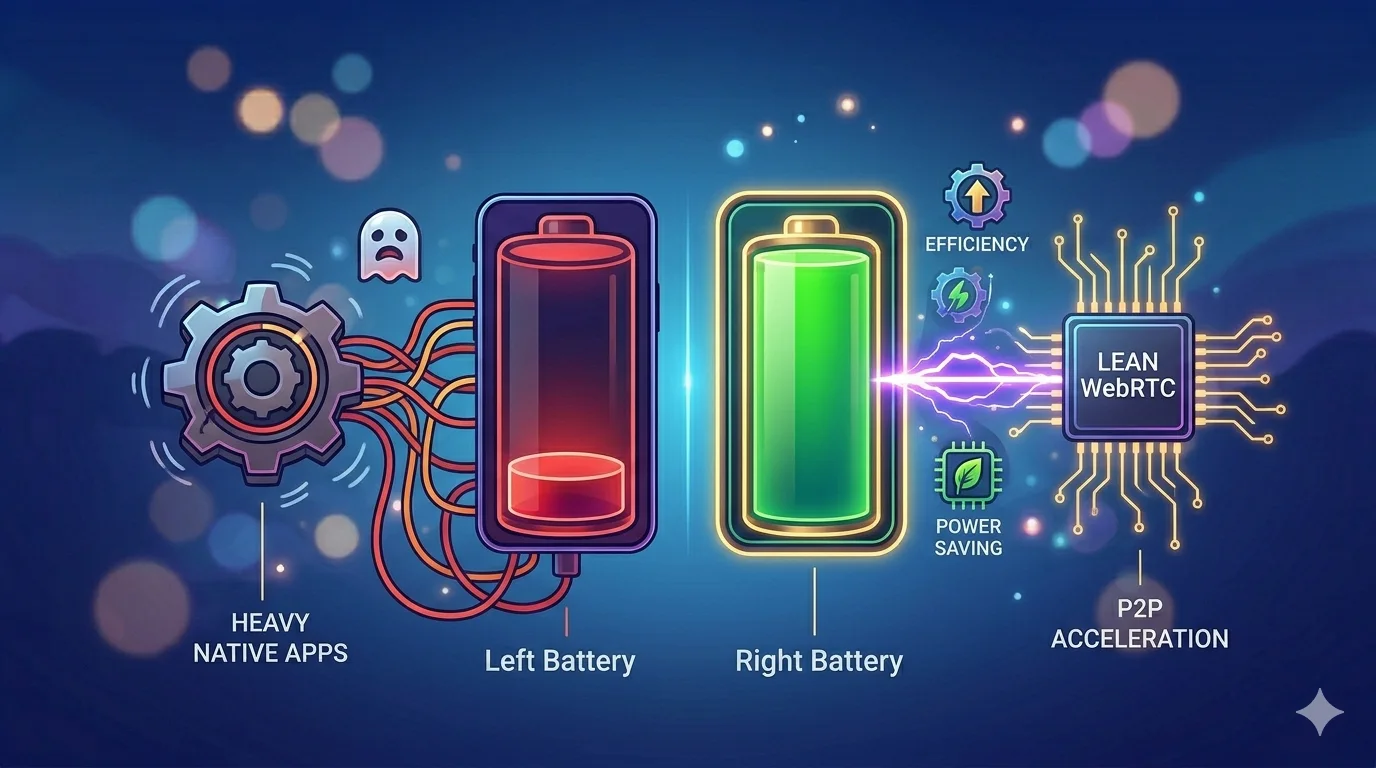
These apps install background listeners on your device's operating system. Even when your phone is in your pocket with the screen off, the app is waking up your CPU (Central Processing Unit) hundreds of times an hour to perform telemetry. It checks your GPS location, it pre-fetches high-resolution images so your feed loads instantly the next time you open it, and it maintains open WebSocket connections to push notification servers.
Waking up the radio antenna (cellular or Wi-Fi) is one of the most power-hungry actions a phone can take. Native apps constantly keep the radio antenna in an active state. Over a 10-hour day, this background polling accounts for a massive percentage of your total battery consumption.
Hardware Acceleration vs. Software Bloatware
Now let's examine active usage. When you are on a 1-on-1 video call, your phone has to decode the incoming video and encode your outgoing camera feed. If done poorly, this will turn your phone into a space heater and drain the battery in an hour.
Traditional social media platforms often build their own proprietary video rendering engines inside their apps so they can overlay complex AR filters, tracking algorithms, and real-time shopping tags over the video. These proprietary engines often rely heavily on the CPU (Software Decoding), which requires immense amounts of electrical energy.
WebRTC, which powers Chatzyo, works differently. Because it is a web standard built directly into Google Chrome, Apple Safari, and Mozilla Firefox, it is given privileged access to your phone's dedicated hardware decoders (like the H.264 or VP8 media engines built into modern Snapdragon or Apple Silicon chips). Hardware decoding is exponentially more energy-efficient than software decoding. It offloads the work from the general-purpose CPU to a specialized chip that sips power, keeping your phone cool and your battery green.
How Adaptive Bitrate Saves Radio Power
In our technical overview of handling poor 4G/5G signals, we discussed "Adaptive Bitrate." This is the engine's ability to lower video quality when you have a weak signal. While the primary goal of this feature is to prevent buffering, it has a brilliant secondary effect: battery preservation.
When you are in an area with a weak cellular signal, your phone's modem has to boost its broadcasting power to reach the cell tower. This uses a massive amount of battery. If a traditional app tries to force a heavy 1080p video upload on a weak signal, the modem will operate at maximum power, draining your battery incredibly fast.
Because WebRTC's Adaptive Bitrate senses this weak connection, it instantly drops your upload quality. By sending less data, your phone's modem doesn't have to work as hard, dramatically extending your battery life during a weak-signal conversation.
The Psychology of Infinite Scroll vs. Intentional Chat
Finally, we must address the human behavioral element of battery drain. Traditional social media is built on the "Infinite Scroll." The UI is designed to keep the screen on, emitting bright light, while your thumb continuously loads new, unoptimized ad videos for hours on end.
Spontaneous social discovery is an intentional act. When you use the "Next" button, you are actively seeking a conversation. If you find a great match in a USA chat or a localized room, you often stop touching the screen. The UI is static. You are just talking. Many users even dim their screen brightness during long, deep conversations because the focus is on the audio and the human connection, not on flashy interface animations. This behavioral shift significantly reduces the energy consumed by the screen—the single largest battery drain on any device.
Frequently Asked Questions About Battery Optimization
Absolutely not. Because we operate in the browser and adhere to a strict privacy policy, we cannot track you when the tab is closed. We don't even require a login, making background tracking technically impossible on our end.
The easiest trick is to lower your screen brightness to about 40%. The camera and WebRTC engine are highly optimized, so the screen itself is usually the biggest power consumer during an active call. Additionally, connecting to Wi-Fi instead of 4G/5G will always save radio power.
Processing two-way video will always generate some thermal output, especially on older devices. However, because WebRTC uses hardware acceleration, it should run noticeably cooler than heavily filtered native video applications.
Conclusion: Efficiency is Empathy
At Chatzyo, we believe that software engineering should respect the user's resources. Your battery life is your lifeline to the digital world, to emergency services, and to your daily productivity. By utilizing pure, browser-based WebRTC protocols, we ensure that connecting with a stranger halfway across the globe doesn't come at the cost of a dead phone by 3 PM. It is a leaner, cleaner, and vastly more efficient way to navigate the internet.