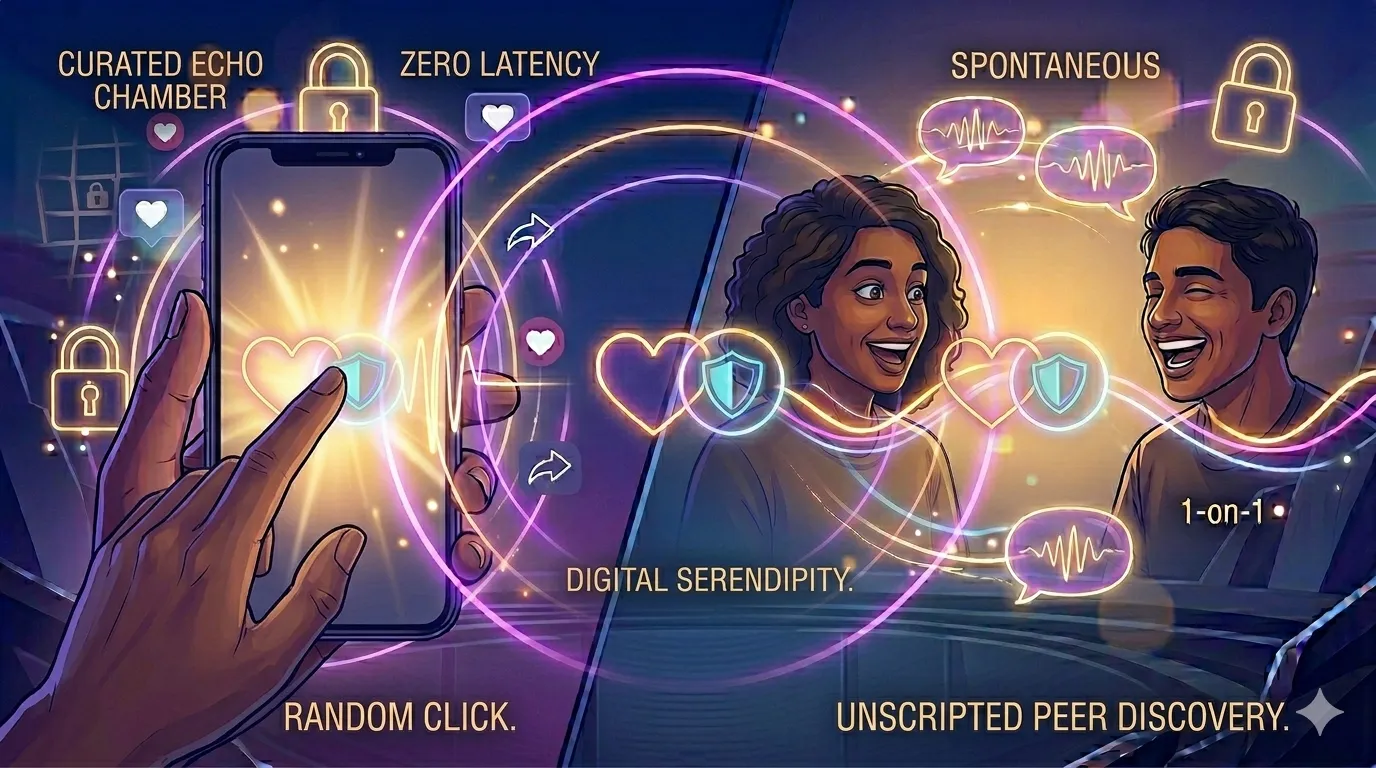
Digital Serendipity: Can a Random Click Truly Change the Course of Your Life?
We often think of our lives as a series of planned events: school, career choices, social circles we’ve meticulously built. Yet, history is written by the unplanned. The chance meeting at a coffee shop, the wrong number that leads to a lifelong friendship, the missed train that results in a career-defining encounter. In the physical world, we call this serendipity—the occurrence and development of events by chance in a happy or beneficial way.
As our lives migrated online, we traded serendipity for "optimization." Algorithms began deciding who we should meet, what we should buy, and what we should think. But in 2026, a counter-movement has taken hold. People are realizing that by over-optimizing their digital lives, they have removed the magic of the unexpected. The question now is: Can a single random click on a 1-on-1 random video chat platform actually change the trajectory of your life? The answer, as we will explore, is a resounding yes.
1. The Death of Serendipity in the Algorithmic Age
For the last decade, social media platforms have functioned as "echo chambers." Their goal is to keep you comfortable by showing you more of what you already like. While this is efficient, it is also stagnant. It prevents Digital Serendipity—the ability to encounter ideas, cultures, and people completely outside of your current bubble.
The social media burnout many feel today is often a result of this lack of surprise. When every interaction is predicted by an algorithm, the "Human Premium" (as explored in our previous dive) disappears. We become bored because we are never challenged. The no-login revolution is the antidote, reintroducing the "Random" factor back into the internet.
2. The Butterfly Effect of a 2-Minute Conversation
In chaos theory, the "Butterfly Effect" suggests that small changes in initial conditions can lead to vastly different outcomes. A single click to start a random video chat session is one such initial condition.
Consider the possibilities of a single random encounter:
- Cultural Paradigm Shifts: Talking to a peer in a UK chat room might give you a perspective on a global issue that fundamentally changes your political or social outlook.
- Creative Inspiration: An artist in Coimbatore might connect with a musician in Brazil, leading to a collaboration that neither could have predicted.
- Career Pivots: Hearing about a specific industry struggle from a stranger might trigger the "aha!" moment for your next business venture.
3. Serendipity vs. Optimization: A Comparison
| Feature | Algorithmic Optimization | Digital Serendipity (P2P) |
|---|---|---|
| Discovery Source | Historical Data / Past Likes | Pure Chance / Randomness |
| Personal Growth | Reinforcement of Existing Views | Challenge and Expansion |
| Connection Type | Predictable / Curated | Raw / Unscripted |
| Privacy Model | Data-Heavy / Tracking | Zero-Data / Anonymous |
4. Reclaiming the "Digital Third Place"
Historically, human growth happened in "Third Places"—neutral ground like public squares, pubs, or parks where people from different walks of life mingled. As these physical spaces disappear, random WebRTC platforms are reclaiming the digital Third Place.
In a Tamil chat room, for example, the interaction isn't just about the language; it's about the spontaneous exchange of local knowledge, humor, and empathy that no search engine can replicate. This "spontaneous mingle" is where serendipity thrives.
5. The Science of Connection: Why "Random" Works
When we encounter something random, our brain’s novelty-seeking pathways are activated. This releases dopamine and increases neuroplasticity—our brain's ability to form new connections. Unlike the "addictive" dopamine of a social media scroll, "serendipitous" dopamine is associated with learning and curiosity. This is why the paradox of anonymity allows us to be so open; our brains are in "discovery mode" rather than "defense mode."
6. The Safety of Chaos: P2P and Privacy
True serendipity requires a lack of inhibition. If you know your "random" chat is being recorded or tied to your permanent identity, you won't be truly open to the experience. This is why WebRTC's P2P architecture is the perfect engine for serendipity. By keeping the data between users and away from central servers, it creates a "safe chaos" where people can truly be themselves.
7. Conclusion: Curating Your Own Luck
You cannot plan for serendipity, but you can architect your life to make it more likely. By choosing to step outside of curated feeds and into the world of spontaneous discovery, you are essentially "curating your own luck." You are increasing the surface area of your life to include the wonderful, the strange, and the transformative.
Next time you find yourself bored with the predictable scroll of your traditional social apps, remember: the most important person you’ll ever meet might be just one random click away. By learning how to talk to strangers safely, you aren't just protecting yourself; you are opening the door to a life-changing moment of digital serendipity.
Frequently Asked Questions
Digital Serendipity is the occurrence of beneficial, unexpected human connections or discoveries in online spaces that are not controlled by predictive algorithms.
By exposing you to people and ideas outside of your social "echo chamber," random chats challenge your biases and activate the brain's novelty-seeking pathways, which are essential for learning and empathy.
When using platforms built on zero-data, no-login WebRTC protocols, the risk is significantly minimized as no personal data is exchanged or stored. However, practicing safe digital hygiene and being aware of community guidelines is always essential.