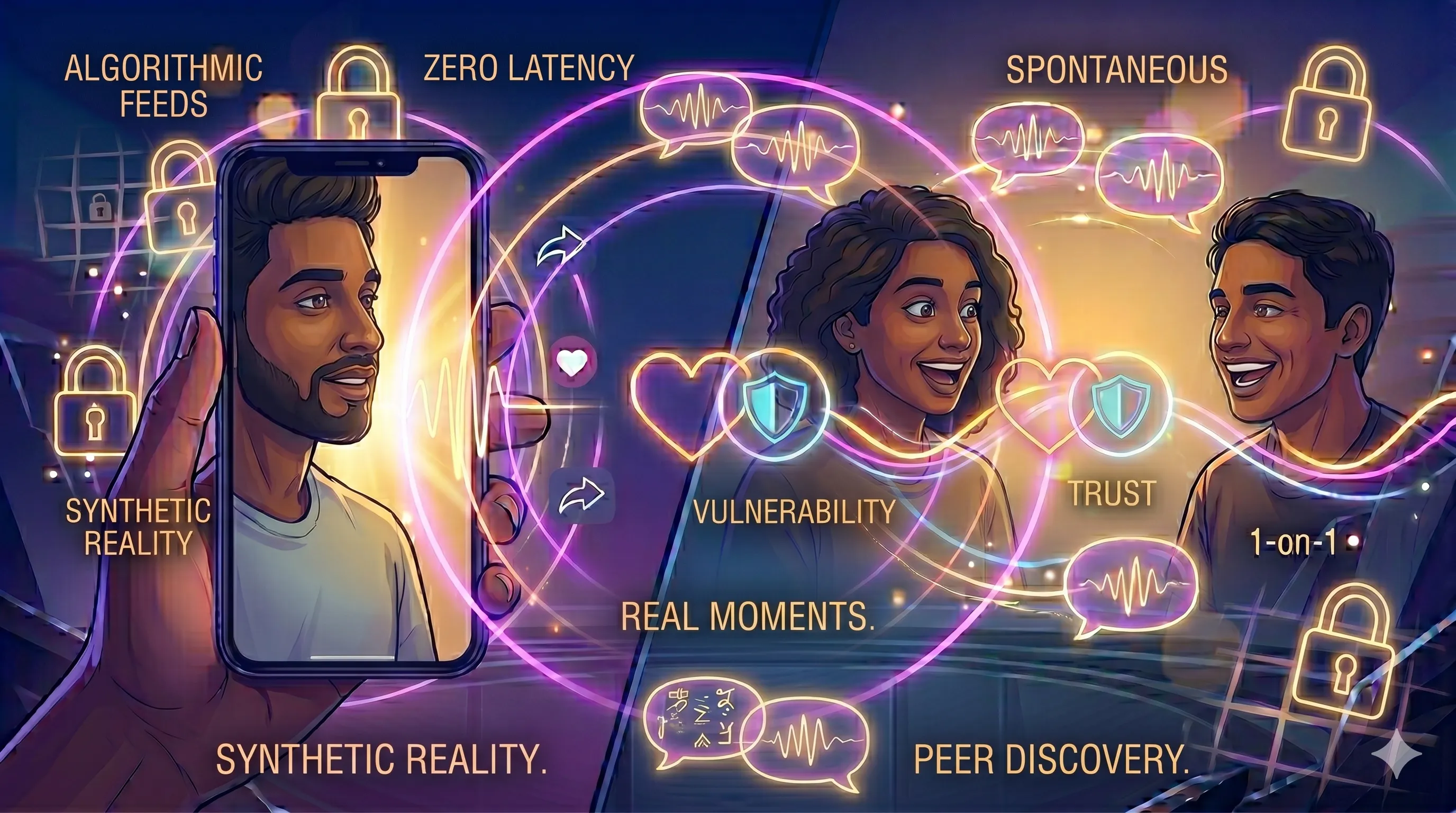
Rebuilding the Human Web: Moving Away from "Follower Counts" to Real Moments
For the past fifteen years, the internet has been built on a single, flawed metric: The Follower. We have measured our social worth in likes, shares, and subscriber counts. This "Attention Economy" has turned every individual into a broadcaster and every conversation into a performance. But in 2026, we are witnessing the collapse of this model. The world is experiencing a profound hunger for what we call "Presence-Based Socializing"—interactions that exist purely for the moment, without the weight of an archive or the pressure of an audience.
To rebuild the human web, we must move away from the broadcasting model and return to the connection model. This means embracing platforms that prioritize 1-on-1 random video chat, spontaneous discovery, and ephemeral interactions. In this final philosophical dive, we analyze why the era of the "Influencer" is being replaced by the era of the "Real Person."
1. The Exhaustion of the Digital Billboard
Traditional social media platforms are essentially digital billboards. When you post a photo or a status, you aren't talking *to* someone; you are talking *at* a crowd. This creates a state of perpetual performance. Even our "private" conversations on these apps are logged, archived, and used to train algorithms. This is the root of the social media burnout that is currently sweeping across all demographics.
Rebuilding the human web requires a return to the Real Moment. A real moment is unrecorded, unquantified, and shared between two human beings in real-time. By utilizing the no-login revolution, we can finally stop managing our digital shadows and start living our digital lives.
2. The "Follower" vs. The "Peer"
In the broadcasting model, the relationship is hierarchical: there is the "Creator" and the "Follower." In the connection model, there is only the "Peer." When you connect in a video chat with a stranger, there is no power dynamic. You are two equal human beings sharing a temporary digital space. This lack of hierarchy is essential for the paradox of anonymity to function, allowing for radical honesty and genuine empathy.
3. Comparative View: Performance vs. Presence
| Metric | Broadcasting (Web 2.0) | Connection (Web 2026) |
|---|---|---|
| Primary Goal | Accumulating Followers | Sharing a Moment |
| Privacy Level | Low (Logged/Archived) | High (Zero-Data) |
| Human Value | The "Follower Count" | The "Human Premium" |
| Social Space | Feed / Echo Chamber | Digital Third Place |
4. Reclaiming the Spontaneity of the Early Internet
The early internet was a place of digital serendipity. You entered a chat room or a forum and met people you would never have encountered in your physical life. Over time, algorithms removed this randomness to make the web "safer" and more "profitable." But safety doesn't have to mean predictability.
By using WebRTC P2P technology, we can bring back that early internet magic. Whether you are in a USA chat or a Tamil chat, the goal is the same: to be surprised. Rebuilding the human web means making space for the unplanned encounter.
5. The Ethics of the Ephemeral
Why does "ephemeral" communication—conversations that vanish—matter so much? Because it allows us to grow. If every mistake we make, every awkward phrase we say, and every experimental opinion we hold is saved in a permanent digital record, we become afraid to change. Ephemeral communication on anonymous Third Places gives us the freedom to be "wrong" and the grace to be human.
6. From "Content" to "Context"
We are drowning in "content." What we lack is "context." Content is a video of someone laughing; context is laughing *with* someone. The move to rebuild the human web is a move toward high-bandwidth, high-context interactions. A 10-minute 1-on-1 call contains more human data than 10,000 text posts. This is the art of the micro-moment.
7. Conclusion: The Real People Revolution
Rebuilding the human web isn't a technological challenge; it's a cultural one. It requires us to value our own presence more than our follower counts. It requires us to seek out the strange, the random, and the unscripted.
By learning how to talk to strangers safely and embracing the privacy-first architecture of the modern web, we can move past the era of the broadcaster and return to what the internet was always supposed to be: a place where humans connect, without the noise of the crowd. The real moment is the only thing that actually matters.
Frequently Asked Questions
Follower counts turn social interaction into a performance. When we focus on reach, we sacrifice the depth and authenticity that can only be found in private, 1-on-1 human moments.
It refers to interactions that focus entirely on the current moment. There is no record, no archive, and no audience—just two people connecting in real-time.
As AI-generated content becomes indistinguishable from "perfect" influencer content, the value of the "Real Person" is increasing. People are trading curated feeds for authentic, unscripted human discovery.